Last updated 2026-08-18
TL;DR
California does not issue a state live scan technician license through BSIS or DCA. You need a California DOJ Live Scan Operator certification and a DOJ-certified site. The operator form is BCIA 8377. Fixed per-applicant fees are $32 DOJ and $17 FBI, plus your rolling fee. Training is short. DOJ processing can run 2 to 8 weeks. No timing guarantee exists.
What does a live scan technician in California actually do?
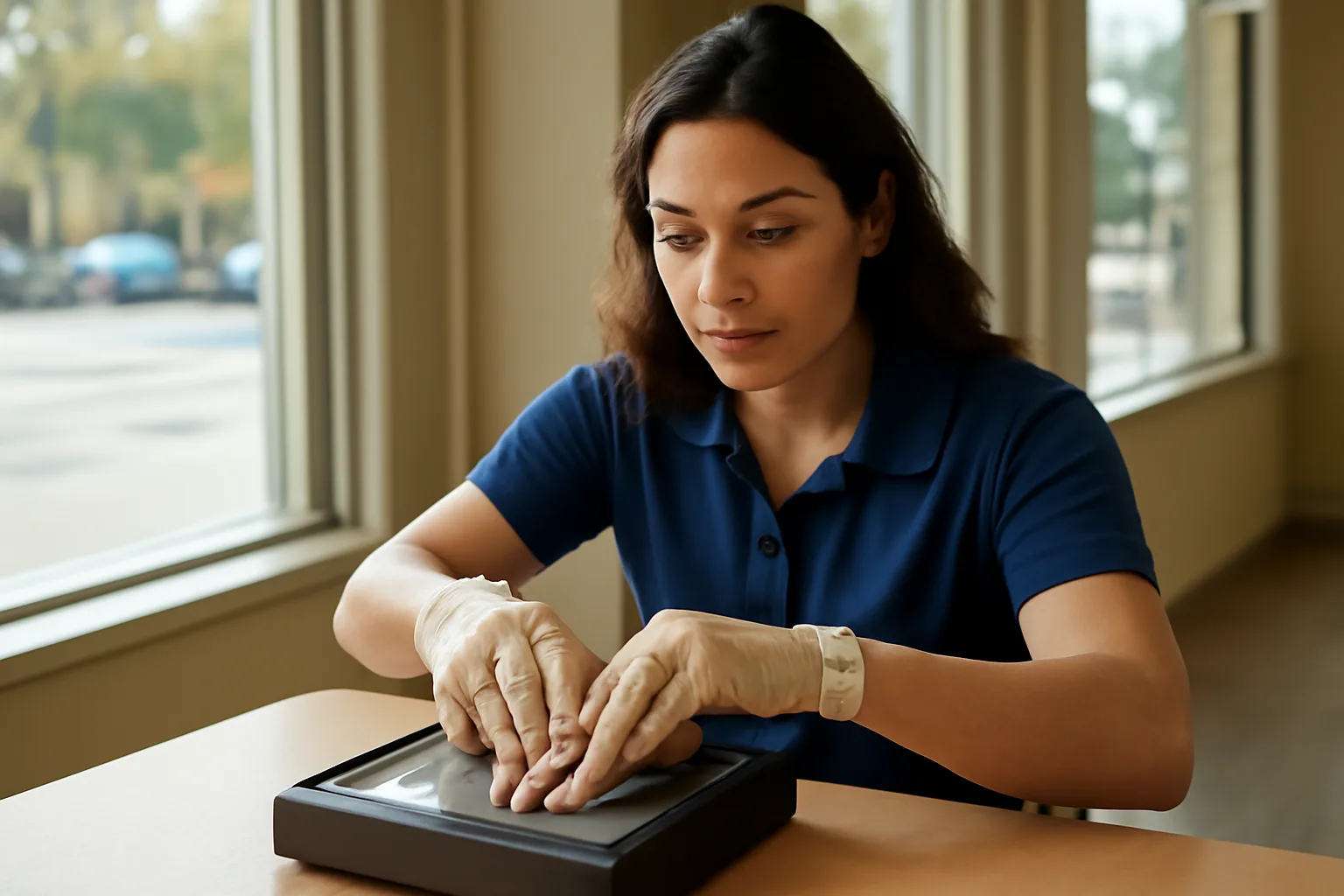
The core job is inkless fingerprint capture. You roll fingers on a glass top, capture clean ridge detail, enter demographic data, and transmit everything to the California Department of Justice. Many scans go to the FBI too. The DOJ describes live scan as "an inkless, electronic process that captures fingerprints and demographic information electronically and transmits the information to the Department of Justice (DOJ) for processing" [4].
Rolling fingers is the easy part. You check government-issued ID, verify that the applicant's name and date of birth match the requesting agency's data, pick the correct ORI and reason code, and handle retakes when the machine flags a poor image. A calm tech who brings a nervous applicant to a clean roll in two tries is worth more than a fast one who racks up rejects.
Live scan replaced most ink cards in California years ago. Employer background checks, foster care, real estate, licensing boards, and some firearm eligibility all use it. Demand is steady in storefronts, mobile units, and shared offices. The work rests on one thing: following DOJ procedure exactly.
Do you need a license to be a live scan technician in California?
No state occupational license, yes DOJ operator certification. California does not issue a live scan technician license through the Bureau of Security and Investigative Services or the Department of Consumer Affairs. The credential that matters is a California DOJ Live Scan Operator certification. You file the Live Scan Operator Certification Application, BCIA 8377, after training [1].
The operator certification is not optional. DOJ uses it to tie each operator to a certified live scan site and to the rules for transmitting fingerprint data. Work under someone else's site and you still need your own operator certification. Start your own site and you need both operator and site certification [5].
The site has to be approved separately. The Live Scan Site Certification Application is its own form. A common mistake is thinking the operator certificate lets you freelance anywhere. It does not. You have to be tied to a certified site with a valid ORI code and DOJ-approved devices [1][5].
Don't spend money on a generic California fingerprinting license package from a private company. No such license exists. The real paper path is DOJ forms.
How much does it cost to start a live scan technician business in California?
The state does not publish a single start-up price for a live scan business. Costs split four ways: fixed per-applicant state fees, training, equipment, and local business registration. The fixed fees on a standard Request for Live Scan Service (BCIA 8016) are $32 for DOJ, $17 for FBI, and $15 for the Child Abuse Central Index when the requesting agency needs that check [2]. Your rolling fee sits on top, and you set it.
Training cost swings by provider. Some live scan operator courses run under $100. Others charge $250 or more for the same DOJ completion certificate. DOJ does not set the private course price, so confirm current pricing before you enroll. Skip any course that promises to certify your business. The operator certification is personal, not a business license.
Equipment is the biggest variable. Used FBI-certified live scan devices often list from about $1,500 to $4,000. New systems with support contracts often run $4,000 to $8,000. Those numbers move with vendors and demand, and they appear on no DOJ fee chart. Before buying, check the FBI Certified Products List and ask CA DOJ or your vendor to confirm California compatibility [6].
Local setup costs are small but real. A city business license or county fictitious business name filing commonly runs $25 to $150. Check your own city. Work from home as a mobile tech and your out-of-pocket might start near $2,000 with used gear. A storefront with new equipment and signage can pass $9,000 before your first appointment.
How long does it take to become a live scan technician in California?
There are two clocks, and they run separately. The training clock is short. A California live scan operator course is usually a half-day, or an online module you finish in one sitting. You then file BCIA 8377 and wait for DOJ to enter your operator record. DOJ publishes no guaranteed processing time for operator certification, so plan on 2 to 8 weeks. Site certification can drag longer if your ORI or device information is incomplete [1][5].
The applicant clock is a different thing. A live scan appointment itself runs 10 to 20 minutes per person. After transmission, DOJ results vary by request type. Most employment checks come back within a few days. Firearm-related checks can take longer. Never promise a client same-day results, because DOJ controls that part, not you.
Starting fresh, budget at least 4 to 6 weeks from training to paying customers. That covers the operator application, site certification, equipment setup, and local business registration. Anyone selling you a one-day business in California is wrong.
What paperwork and training do you need first?
Get four things in order before you open. Finish DOJ-approved live scan operator training. File the Live Scan Operator Certification Application, BCIA 8377 [1]. If you'll own or operate a site, file the Live Scan Site Certification Application with your device and ORI information [5]. Set up a local business registration so your city or county recognizes you. Order matters, because in many cases DOJ will not certify an operator who isn't tied to a site or a pending site application.
The BCIA 8377 form asks for your legal name, your training completion details, and the certified site where you'll operate. You have to report a change of site or equipment when it happens. Keep copies of every submission. DOJ often returns forms by mail or asks for corrections, so a small binder with form numbers, dates, and confirmation numbers saves you grief.
Want a clean checklist? A $149 one-time Live-Scan Site Kit gives you the CA-specific forms and the order to file them. It does not replace DOJ certification and it does not file for you. Use it as a map, not an approval.
How do you get a Live Scan site certified in California?
Site certification is a separate track from operator certification. You file the Live Scan Site Certification Application with the California DOJ. The form asks for the site's physical address, the responsible operator, the ORI code you'll use, and the make and model of your fingerprint device [5]. A site can be a fixed storefront, a mobile vehicle, or a room in a shared office, but DOJ has to know where the equipment lives and who is accountable.
You cannot send live scan transactions to DOJ from an uncertified site. DOJ checks that the equipment and site match before it turns on your electronic submission path. Change your address, phone, or device, and you file the DOJ change form. Buy another machine, and don't assume the old site certification covers it.
One piece of practical advice. Confirm your ORI code with the agency whose applicants you'll serve. Your ORI carries the reason codes and fees for that requesting agency. A licensed employer may have one ORI. A school district may have another. Site certification alone does not let you use just any ORI.
What fingerprint equipment is required in California?
Buy only a device on the FBI Certified Products List. That list shows hardware approved for electronic capture and transmission to the FBI, and California DOJ submissions need a compatible machine [6]. Some devices are certified for ten-print capture but not palm prints. Plan to serve agencies that need palm scans, and you have to confirm the model supports it.
New operators tend to overbuy. A used unit from the FBI list, with a recent calibration and a vendor support line, usually covers a first-year site. Look for a device that runs a daily image quality check. Poor ridge detail causes more rejects and scheduling pain than any other single problem.
You also need a computer, a secure internet connection, and backup storage for your daily logs. DOJ does not require a specific printer, but you have to hand the applicant the transaction copy from the Request for Live Scan Service form. A plain letter printer works. The gear to avoid is any fingerprint scanner sold by a non-law-enforcement vendor that isn't on the FBI list, no matter how cheap it is.
What can you charge per applicant in California?
The fixed fees on BCIA 8016 are set by the state and the FBI: $32 DOJ, $17 FBI, and $15 CACI when it applies [2]. You pass those straight through to the applicant. Your profit comes from the rolling fee, the amount you set for the capture itself. California rolling fees commonly run $20 to $35 at storefronts. Mobile services charge more for travel.
A typical storefront total lands at $69 to $84 when all three state fees apply, before any mobile surcharge. Some sites in high-rent areas charge $90 or more. Some low-volume rural sites charge less. The state does not cap your rolling fee, but price too high and applicants walk to the next certified site. Start at the local median and raise only after volume builds and your early appointment slots fill.
You'll see charts listing a live scan cost of $49 or $59. Those usually drop the FBI fee or assume a $20 rolling fee. Quote from the BCIA 8016 fee boxes so your price is complete, not a teaser.
What most people get wrong about California live scan technician work
The biggest error is treating this like an unlicensed side hustle. DOJ regulates it, and sending fingerprints without operator and site certification can get your transmission ability cut off. The second error is buying hardware before you know the agency ORI and reason codes you'll need. The third is quoting a background check result time to an applicant. You don't control DOJ processing, so promise only that the scan was transmitted.
Another miss: assuming FBI and DOJ accept any device with a fingerprint icon on the box. They don't. The FBI Certified Products List is the gate [6]. If a vendor can't show you the model on that list, walk away.
Don't pay for a national live scan license either. No such national license exists. California, Arizona, Colorado, and Utah each run their own path. How to start a live scan technician in Arizona, Colorado, Utah license, and the California license guide.
How California compares to nearby states
California's path is DOJ operator and site certification. Arizona runs its own fingerprint technician rules. Colorado and Utah differ again. Plan to work border counties, and you should check the state guide for each before you buy equipment that may not cross over. How to start a live scan technician in Arizona, Colorado, Utah license.
For the California credential details, see the California license guide. The bottom line is simple. The California DOJ operator certification is not a federal credential, and a fingerprint card from another state does not transfer on its own.
The short version of what to do first
Do this in order. Finish DOJ-approved operator training. File BCIA 8377 for operator certification [1]. File the site certification if you own the site [5]. Check the FBI Certified Products List before you buy [6]. Set a rolling fee that covers your time and passes through $32 DOJ and $17 FBI [2]. Take your first paid appointment only after DOJ activates your site.
LiveScanPath sells a $149 one-time Live-Scan Site Kit for California paperwork. It's useful if you want the forms and the filing order in one place. It is not a law firm, it is not a government agency, and it cannot guarantee DOJ approval or timing.
Frequently asked questions
Do you need a license for live-scan technician in California?
No separate state occupational license exists. You need a California DOJ Live Scan Operator certification (BCIA 8377) and you must work under a DOJ-certified live scan site. The Bureau of Security and Investigative Services does not issue a live scan technician license. The operator certification is the credential that controls.
How much does live-scan technician cost in California?
Fixed state fees per applicant are $32 DOJ and $17 FBI, plus $15 Child Abuse Central Index when that check applies. Your rolling fee is added by the site. Start-up costs vary: used FBI-certified equipment often starts around $1,500 to $4,000, training runs under or over $250, and local business fees vary by city.
How long does live-scan technician take in California?
The appointment takes 10 to 20 minutes per person. Getting certified takes longer: training is a day or less, then DOJ operator and site certification can run 2 to 8 weeks. DOJ background check results vary by request type. Do not promise same-day results.
What is the difference between a live scan operator and a live scan site in California?
The operator is the person certified to roll fingerprints and transmit data. The site is the physical location, mobile unit, or business address certified by CA DOJ to house the equipment and ORI. You need separate forms: BCIA 8377 for the operator and a site certification application for the site.
Can I start a mobile live scan business in California?
Yes, but DOJ still certifies the site, which can be a mobile vehicle. You report the physical address and responsible operator, and the equipment has to stay on the FBI list. Mobile services can charge a travel fee on top of the rolling fee. Confirm mobile site certification details with DOJ before buying a vehicle wrap.
What forms do I file to become a live scan operator in California?
File the Live Scan Operator Certification Application, BCIA 8377, after completing DOJ-approved training [1]. If you own or operate the location, also file the Live Scan Site Certification Application [5]. You may need a change form later for any address, device, or ORI change.
Do I need a business license in California for a live scan site?
Yes, separate from DOJ certification. A city business license or county fictitious business name filing is commonly required. California business registration happens at the local level, not through DOJ. Check your city or county before you open, because fees and forms vary.
Can I use any fingerprint scanner for California live scan?
No. The device has to be on the FBI Certified Products List and compatible with California DOJ submissions [6]. Some scanners are certified for ten-print but not palm print capture. A budget scanner from a generic office vendor is not enough, no matter what the marketing says.
How much can a live scan technician make per applicant in California?
Your profit is the rolling fee, commonly $20 to $35 at storefront locations after passing through $32 DOJ and $17 FBI. Mobile services can charge more for travel. A storefront total often lands between $69 and $84 when CACI applies. Volume and location matter more than a high single rolling fee.
How often does the California DOJ live scan operator certification need renewal?
The DOJ operator certification has no fixed multi-year renewal the way a driver license does, but operators must report site, device, name, or contact changes on the proper DOJ form. Rely on the current BCIA 8377 instructions and any recertification notice from DOJ. Do not assume a certificate is permanent.
Is California live scan operator certification transferable from another state?
No. A fingerprinting credential or license from another state does not transfer to California on its own. You still complete CA DOJ operator certification and site requirements. California's system uses its own ORI structure and DOJ protocols, even if your previous state used FBI-certified equipment.
Does the California DOJ charge a filing fee for operator certification?
The BCIA 8377 operator application is processed by DOJ, but private training cost is your main initial outlay. Check the current BCIA 8377 form and the DOJ live scan forms page for any changed filing fee. DOJ does not publish a single flat start-a-business price, because equipment and local fees vary.
What ORI do I need for California live scan?
The ORI code comes from the authorized agency requesting the background check, not from you. You transmit under the requesting agency's ORI and reason code. Confirm the ORI before the appointment. If you serve multiple agencies, keep a current ORI list. A wrong ORI sends the scan to the wrong place and creates a reject.
Can a live scan technician work from home in California?
Yes in many cases, if the home location is certified as the live scan site and local zoning allows a home business. Mobile and home-based sites still need DOJ site certification, an FBI-listed device, and a valid ORI. Check city rules for client traffic, parking, and signage before you advertise a home address.
Sources
- California Department of Justice, Live Scan Operator Certification Application (BCIA 8377): BCIA 8377 is the California DOJ operator certification application.
- California Department of Justice, Request for Live Scan Service (BCIA 8016): Fee fields are DOJ $32, FBI $17, and Child Abuse Central Index $15; rolling fee is set by the site.
- California Department of Justice, Live Scan Forms: Page lists operator certification, site certification, and change forms.
- California Department of Justice, Live Scan: Live scan transmits fingerprint and demographic information electronically to the California DOJ.
- California Department of Justice, Live Scan Site Certification Application: Site certification is separate from operator certification and requires address, operator, ORI, and device information.
- California Secretary of State, Starting a Business: Business registration in California is separate from any occupational credential.
- U.S. Small Business Administration, Register Your Business: Local business license and registration requirements vary by city and county.
- California Department of Justice, Fingerprinting: DOJ and FBI fingerprint processing fees are set out on the California DOJ fingerprinting page.
- California Governor's Office of Business and Economic Development: California business permits and licenses vary by city, county, and activity.