Last updated 2026-08-18
TL;DR
Vermont does not have a state licensing board specifically for live-scan technicians. There is no Vermont-issued live-scan technician license. Fingerprint submissions go through the Vermont Crime Information Center, which connects to the FBI's NGI system. Costs vary by agency and purpose. Anyone setting up a site still needs to meet FBI-approved channeler requirements and any applicable business registration rules.
Does Vermont have a live-scan technician licensing board?
No. Vermont does not have a dedicated state board that licenses live-scan fingerprint technicians. There is no Vermont live-scan technician certificate, no state-issued credential, and no continuing-education requirement tied to that credential. That is the honest answer, and it matters because a lot of national training vendors imply otherwise.
What Vermont does have is the Vermont Crime Information Center (VCIC), the state's central repository for criminal history information. VCIC sits inside the Vermont Department of Public Safety and acts as the gateway between fingerprint submitters and the FBI's Next Generation Identification (NGI) system [1]. Want to submit electronic fingerprints for a Vermont background check? You work within VCIC's rules, not a technician board's rules.
The distinction is real. Process-level requirements still exist. The FBI sets technical standards for livescan devices, image quality, and data formatting. Channelers approved by the FBI (private companies authorized to submit prints to NGI) have their own enrollment agreements and quality standards. None of that adds up to a Vermont state board you need to pass an exam in front of.
Do you need a license to operate as a live-scan technician in Vermont?
Not at the state level, no. Vermont does not require a fingerprint technician license the way California does. California's Department of Justice requires Live Scan site operators to be on an approved roster and execute an Applicant Submission Agreement [2]. Vermont has no equivalent program.
But "no state license" does not mean "no requirements at all." A few things still apply.
First, if you run a fingerprinting business, Vermont requires standard business registration. You register with the Vermont Secretary of State's Office and follow any local business rules [3]. That's true of any service business, not something unique to fingerprinting.
Second, the entity authorizing your prints matters. If you're submitting prints on behalf of a professional licensing board, a school, or a federal agency, that entity's channeler may impose its own enrollment steps, background checks on the technician, and quality assurance audits. The FBI's CJIS (Criminal Justice Information Services) Division also sets Security Policy requirements that apply to anyone accessing criminal justice information, and those requirements are real whether or not your state has a technician board [4].
Third, some fingerprinting purposes are tightly controlled. Vermont state employees and applicants for certain licensed professions (nursing, education, childcare) go through fingerprint background checks with specific authorized submitters. If you want to be an authorized submitter in one of those pipelines, you apply to be recognized by the relevant Vermont agency, not a technician board.
The practical answer: you don't pass a Vermont exam or carry a Vermont card. You do need to enroll with the right channeler, meet FBI CJIS standards, and register your business.
How does the Vermont Crime Information Center (VCIC) fit into this?
VCIC is the operational center for Vermont fingerprint submissions. It maintains Vermont's criminal history records and processes both in-state criminal history requests and submissions to the FBI's NGI system [1].
For most non-criminal-justice fingerprint submissions (employment, licensing, volunteer screening), a Vermont submitter uses an FBI-approved channeler rather than sending prints straight to VCIC. The channeler processes the electronic print file, checks it against FBI records, and sends results back. VCIC handles state-level Vermont record queries separately.
VCIC also manages the technical specifications for submissions. That covers file format standards (ANSI/NIST-ITL), image resolution requirements (typically 500 ppi for rolled impressions), and transmission protocols [4]. A livescan device that misses these standards gets prints rejected. Here's where technical competence matters more than a license: a rejected print causes delays and may force the applicant to come back.
VCIC's contact information and current submission guidance are on the Vermont Department of Public Safety's website. Fee schedules and authorized submitter lists change periodically, so confirm current details directly with VCIC rather than trusting any third-party summary, including this one.
How much does a live-scan fingerprint submission cost in Vermont?
Here's where the answer gets genuinely variable, and anyone who hands you a single clean number is oversimplifying.
The cost of a live-scan fingerprint transaction in Vermont depends on three separate parts: the state repository fee (what VCIC or the relevant Vermont agency charges to search state records), the FBI fee (what the FBI charges per NGI submission), and the service or rolling fee (what the fingerprint site charges for the technician's time and equipment).
The FBI's standard Identity History Summary Check fee for non-criminal-justice purposes is $18 per submission [5]. That fee goes to the FBI and stays consistent nationwide. Vermont's state-level criminal history check fees are set by statute and administered through VCIC. Confirm the current rate with VCIC directly [6].
The rolling or service fee is whatever the site charges. It runs roughly $10 to $35 depending on location, volume, and whether the site is a commercial provider, a police department, or a staffing firm. Some sites bundle state and FBI fees into a single quoted price. Others quote just the rolling fee and leave the state and FBI components to be paid separately through the channeler.
The table below shows the general structure of a Vermont live-scan transaction cost, using the one fee that is publicly fixed (FBI) alongside approximate ranges for the variable parts.
| Cost Component | Who Sets It | Approximate Range |
|---|---|---|
| FBI NGI submission fee | FBI / CJIS | $18.00 (fixed) [5] |
| Vermont state repository fee | VT Dept. of Public Safety | Confirm with VCIC [6] |
| Technician / rolling fee | Individual site | $10 to $35 (estimated) |
| Typical total | $30 to $70+ |
Those total range figures are rough estimates based on what comparable small northeastern states charge. Don't treat them as guaranteed. Confirm exact fees with the fingerprint site and with VCIC before you schedule an applicant.
How long does a live-scan fingerprint process take in Vermont?
The actual fingerprint rolling appointment takes 10 to 20 minutes for most applicants. That's the time you're in the chair: fingers cleaned, rolled on the scanner, image quality verified. Complicated prints (dry skin, worn ridges, calluses) take longer.
Turnaround for results is a different question. Vermont state-level criminal history checks through VCIC can return in a matter of days for clean records. FBI NGI checks for non-criminal-justice purposes can take a few days to a few weeks depending on current FBI processing volume and whether the applicant has any record requiring manual review [5].
The FBI notes that the Identity History Summary process may take up to 18 weeks in cases where manual review is needed, though routine submissions are often faster [5]. Vermont-specific processing times through authorized channelers are not publicly standardized. Individual channelers may post estimated turnaround times on their websites, but those are estimates, not guarantees.
If a print is rejected for quality reasons (poor image, incomplete capture), the applicant has to return for a resubmission, which adds delay. Technician skill matters even in a state with no technician licensing board: a competent roller with a properly calibrated device minimizes rejections.
What do you actually need to set up a live-scan fingerprinting site in Vermont?
Setting up as a fingerprint technician or running a fingerprinting site in Vermont means working through the FBI channeler framework rather than a state board framework. Here's what that path looks like in practice.
You need an FBI-approved livescan device. The FBI maintains a list of certified livescan devices that meet NGI submission standards [4]. Buying an uncertified device is an expensive mistake: it won't be accepted for submission. Devices range from around $3,000 for entry-level certified scanners to $10,000 and up for full-featured units. Used certified equipment is available and can cut that cost a lot, but verify the device is still on the current certified list before you buy.
You need a channeler enrollment agreement. Depending on which submission types you plan to handle (employment, licensing, child-care, federal agencies), you enroll with one or more FBI-approved channelers. Each channeler has its own enrollment process, may require a site inspection or background check, and sets the transaction fees it will charge.
You need to meet FBI CJIS Security Policy requirements. The CJIS Security Policy covers physical security of the device and print data, personnel background checks for anyone who accesses the system, and network security if you transmit data electronically [4]. These are federal requirements that apply no matter what Vermont does or doesn't require.
You need Vermont business registration if you operate as a business. The Vermont Secretary of State handles business registrations online [3].
Running a mobile or multi-site operation? Operational details like record-keeping, storage of biometric data, and client contracts deserve attention before your first appointment. LiveScanPath's site-setup resources at /start cover the paperwork side for technicians building a first operation, including what a client intake form and submission log should actually contain.
For a fuller look at how neighboring states handle technician requirements, the guides on live-scan technician board in Connecticut and live-scan technician board in New York are worth reading, since the northeast regional pattern is relevant to Vermont submitters who may also operate across state lines.
What FBI CJIS requirements apply to Vermont live-scan sites?
The FBI's CJIS Security Policy is the foundational document for anyone handling fingerprint submissions that touch the NGI system, and it applies in Vermont exactly as it applies in every other state [4]. Vermont state agencies that access criminal justice information sign a CJIS User Agreement, and private channelers operating in Vermont are bound by their FBI channeler agreements, which incorporate CJIS standards.
For a typical small fingerprinting site, the policy focuses on physical access controls (who can touch the device and the data), personnel screening (background checks for staff), data encryption for any electronic transmission, and audit logging. The policy is updated periodically; the current version at the time of writing is CJIS Security Policy v5.9.5, released in October 2023 [4].
This is not light reading, but skipping it is the biggest mistake new technicians make. Vermont doesn't hand out fingerprint-technician fines. Loss of channeler access is the real outcome if an audit finds policy violations, and that ends your business overnight.
Which Vermont agencies require live-scan fingerprinting for applicants?
Several Vermont professional licensing boards and state agencies require electronic fingerprint background checks for applicants. The Vermont Agency of Education requires fingerprint-based background checks for applicants for educator licenses under Vermont Statutes Annotated Title 16 [7]. The Vermont Department for Children and Families requires fingerprint background checks for childcare and residential facility workers [8].
Healthcare licensing boards in Vermont, including nursing and medicine, also require fingerprint-based federal background checks as part of initial licensure. When an applicant goes through one of these processes, the authorized submitter list is typically controlled by the relevant agency or the channeler that agency has contracted with. Not every fingerprint site in Vermont is authorized for every submission type.
Understand this early. If your plan is to serve nursing license applicants, confirm which channeler the Vermont Office of Professional Regulation uses for that submission type and whether you can enroll with it. One channeler does not cover all purposes.
How does Vermont compare to states that do license live-scan technicians?
Most states fall somewhere on a spectrum from "no technician requirements at all" (Vermont's position) to "full state licensing with exams, fees, and renewal" (California's position).
California requires Live Scan site operators to execute an Applicant Submission Agreement with the California Department of Justice and appear as an approved site [2]. Arizona runs its own state-level requirements through the Arizona Department of Public Safety. States that manage their own criminal history repositories tend to impose more process-level rules on submitters.
Vermont's light regulatory touch matches its general approach to occupational licensing. A 2022 Institute for Justice analysis ranked Vermont among states with lower overall occupational licensing burdens, though that report looked at licensed occupations broadly, not fingerprinting specifically [9].
The practical implication: if you're a technician licensed in California or another heavily regulated state and you want to operate in Vermont, you face fewer hoops, not more. You still have to meet the FBI channeler requirements, which are the real baseline everywhere.
For context on how other states structure this, see the guides on live-scan technician board in Florida, live-scan technician board in Colorado, and live-scan technician board in California.
Is there any Vermont-specific training or certification worth getting?
There's no Vermont state training program for fingerprint technicians because there's no Vermont technician board. What exists is training offered by livescan device manufacturers, FBI-approved channelers (some require a short orientation), and a handful of private training vendors.
The channeler you enroll with may require a brief online training module or orientation before you can submit transactions. Take that seriously: channeler-imposed training is the closest thing to mandatory training in this space for Vermont technicians.
Beyond that, hands-on practice beats any certificate. Knowing how to handle difficult prints (older applicants, manual laborers, people with skin conditions) comes from rolling hundreds of prints, not from watching a video. If you're starting fresh, shadowing an experienced technician for a day or two is worth more than most paid courses.
Still, understanding the ANSI/NIST-ITL standards and FBI quality specifications is genuinely useful, and free documentation is available directly from the FBI and NIST [10]. If you want a structured start-up document set, LiveScanPath's $149 one-time Live-Scan Site Kit at /start includes the intake forms, submission logs, and client documentation templates that a new Vermont site would actually use.
What should a Vermont applicant expect when they show up for a live-scan appointment?
This is the consumer-facing side, and it helps to know what a good technician's workflow looks like.
The applicant should arrive with a valid government-issued photo ID. Many submission types also require the applicant to bring a pre-completed form or an authorization document from the requesting agency (an ORI number, a case number, or a form from the licensing board). The technician needs that information to populate the transaction correctly before a single finger is rolled.
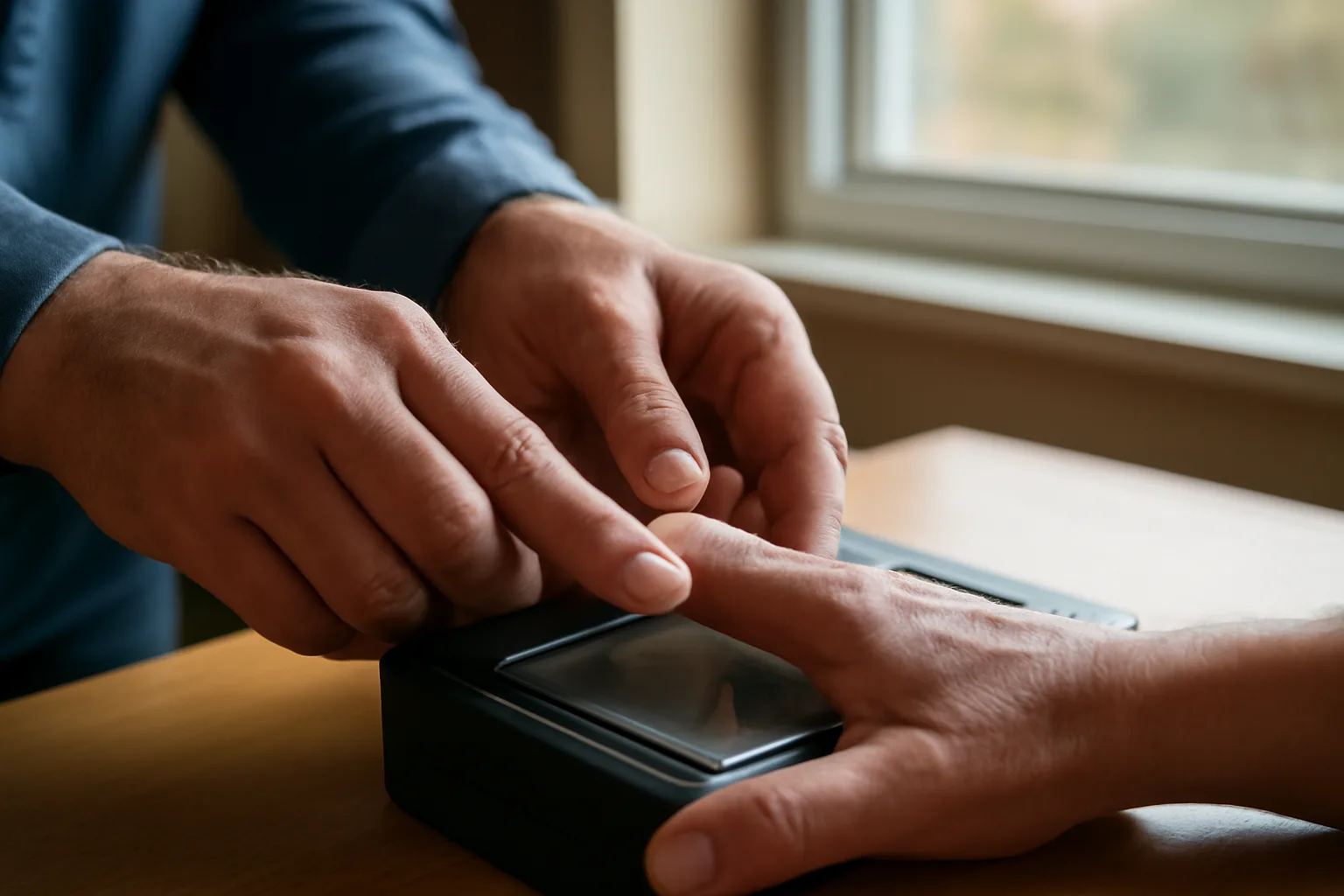
The technician cleans the applicant's fingers with a lint roller or alcohol wipe, then captures each finger individually as flat impressions, followed by four-finger slap impressions and both thumbs. The livescan software displays image quality scores in real time. A good technician rerolls any finger that scores below threshold before submitting the file.
The whole appointment runs about 10 to 15 minutes for a cooperative applicant with average-quality prints. The technician gives the applicant a transaction control number (TCN) to track the submission.
Applicants should not expect to see their own results at the fingerprint site. Results go directly to the requesting agency or channeler, not to the applicant, in most background check scenarios.
Frequently asked questions
Do you need a license for live-scan technician in Vermont?
No. Vermont does not have a state licensing board or technician credential for live-scan fingerprinting. There is no Vermont exam, certificate, or renewal requirement. You still need to meet FBI CJIS Security Policy standards and enroll with an FBI-approved channeler, but those are federal requirements, not a Vermont license. Business registration with the Vermont Secretary of State applies if you operate a fingerprinting business.
How much does live-scan fingerprinting cost in Vermont?
A complete Vermont live-scan transaction typically totals $30 to $70 or more, depending on the site. The FBI's NGI submission fee is fixed at $18 per transaction. Vermont's state repository fee is set by the Department of Public Safety; confirm the current amount with VCIC. The fingerprint site adds a rolling or service fee, usually $10 to $35. Some sites quote all-in prices; others quote components separately.
How long does live-scan fingerprinting take in Vermont?
The appointment itself takes 10 to 20 minutes. Results turnaround varies: Vermont state-level checks through VCIC can return in a few days for clear records. FBI NGI checks for non-criminal-justice purposes are often completed in days to a few weeks, but the FBI notes that manual review cases can take up to 18 weeks. Rejected prints due to quality issues require a resubmission and add additional delay.
Who oversees live-scan fingerprint submissions in Vermont?
The Vermont Crime Information Center (VCIC), part of the Vermont Department of Public Safety, is the state's central repository for criminal history records. VCIC manages Vermont-level criminal history queries and connects to the FBI's NGI system. Private FBI-approved channelers handle most non-criminal-justice electronic fingerprint submissions. There is no separate Vermont technician board.
Can I start a live-scan fingerprinting business in Vermont without a state license?
Yes, in the sense that Vermont has no technician licensing requirement. You still need to register your business with the Vermont Secretary of State, enroll with an FBI-approved channeler, purchase a certified livescan device, and comply with the FBI CJIS Security Policy. Depending on the submission types you want to handle, individual Vermont agencies may have their own authorized submitter requirements.
What is the FBI CJIS Security Policy and does it apply in Vermont?
The CJIS Security Policy is the FBI's framework governing physical, personnel, and data security for anyone who handles submissions to the NGI fingerprint system. It applies nationwide, including Vermont. The current version is v5.9.5 (October 2023). Key requirements include physical access controls, personnel background checks, data encryption, and audit logging. Vermont's lack of a technician board does not exempt you from CJIS requirements.
Which Vermont professions require fingerprint background checks?
Vermont educator license applicants, childcare and residential facility workers, and various healthcare licensees (nursing, medicine, and others) are required to undergo fingerprint-based background checks. Each program uses specific authorized submitters or channelers. If you want to serve applicants for a particular profession, confirm which channeler that Vermont agency uses and whether you can enroll with it.
Do I need to use a specific livescan device in Vermont?
You need an FBI-certified livescan device. The FBI maintains a list of devices certified to meet NGI image quality and format standards. Using an uncertified device means your submissions will be rejected. Certified devices start around $3,000 for entry-level models. Used certified equipment is available but verify the model is still on the current FBI certified list before buying.
Can I operate a mobile live-scan fingerprinting service in Vermont?
Yes, mobile fingerprinting is operationally possible in Vermont since there is no state board restricting it. You still need a certified portable livescan device, a channeler enrollment agreement, and compliance with FBI CJIS Security Policy requirements for mobile or off-site collection, which include specific rules for device security and data handling when operating outside a fixed facility.
What information does an applicant need to bring to a Vermont live-scan appointment?
A valid government-issued photo ID is required. Most submission types also require an authorization document or form from the requesting agency, including an ORI number or case reference number. Without the correct ORI or agency identifier, the technician cannot populate the transaction record correctly, and the submission may be rejected or returned to the wrong recipient.
How do I find an authorized live-scan fingerprint site in Vermont?
VCIC and individual Vermont licensing agencies maintain lists of authorized submitters for their specific programs. The FBI-approved channeler you would enroll with can also direct you to participating sites. There is no single public Vermont state directory of all fingerprint sites, so the best approach is to contact the requesting agency (a licensing board, employer, or school) and ask which sites they accept submissions from.
Does Vermont require a background check on the live-scan technician themselves?
Vermont has no state-mandated background check for fingerprint technicians. However, FBI CJIS Security Policy requires personnel screening for individuals with access to criminal justice information systems. The specific channeler you enroll with may also require a background check on technicians as part of their enrollment agreement. Confirm requirements with your channeler before hiring staff.
Sources
- Vermont Department of Public Safety, Vermont Crime Information Center: VCIC is Vermont's central repository for criminal history information and connects to the FBI's NGI system
- California Department of Justice, Live Scan Applicant Submission Agreement: California requires Live Scan site operators to execute an Applicant Submission Agreement and be listed as an approved site
- Vermont Secretary of State, Business Registration: Vermont businesses must register with the Vermont Secretary of State's Office
- FBI CJIS Division, Criminal Justice Information Services Security Policy: CJIS Security Policy v5.9.5 sets physical, personnel, and data security requirements for NGI submissions, and specifies technical standards including ANSI/NIST-ITL file formats
- FBI CJIS Division, Identity History Summary Checks: The FBI charges $18 per Identity History Summary Check for non-criminal-justice purposes, and notes processing can take up to 18 weeks in manual review cases
- Vermont Department for Children and Families, Background Check Requirements: Vermont Department for Children and Families requires fingerprint background checks for childcare and residential facility workers
- Institute for Justice, License to Work 3rd Edition (2022): Vermont ranks among states with lower overall occupational licensing burdens in IJ's 2022 analysis
- NIST, ANSI/NIST-ITL Standard for Biometric Data Interchange: NIST publishes ANSI/NIST-ITL standards covering fingerprint image quality and data format requirements for electronic submissions