Last updated 2026-08-18
TL;DR
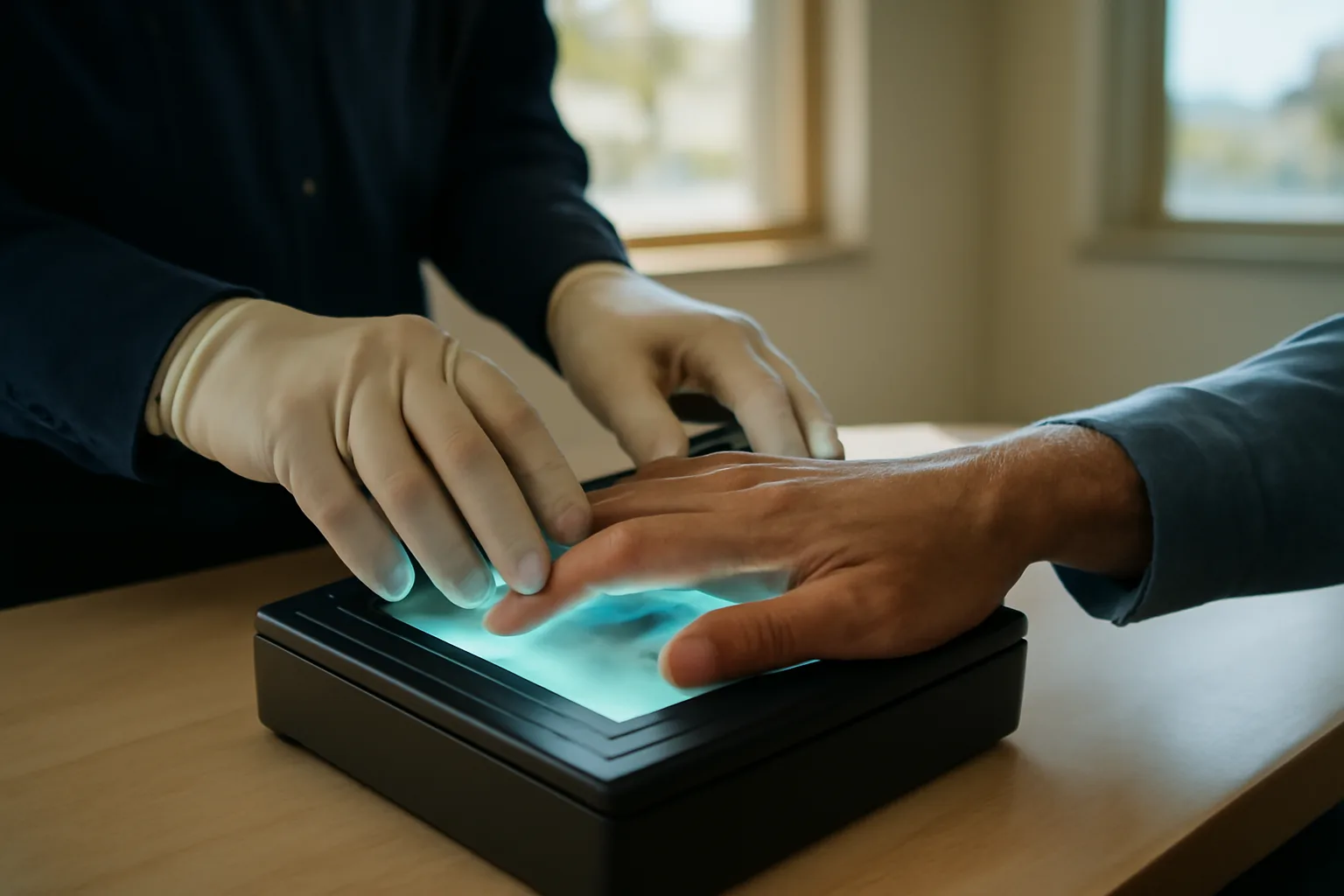
Utah does not issue a state license specifically for live-scan technicians, but the Bureau of Criminal Identification (BCI) must approve any site rolling fingerprints for criminal-history purposes. Startup costs typically run $50 to $300 for training and certification, plus $4,000 to $12,000 or more for equipment. A single fingerprint appointment takes 10 to 20 minutes on-site.
Do you need a license to be a live-scan technician in Utah?
Short answer: not a technician-level license in the traditional sense, but you cannot legally submit electronic fingerprints for Utah criminal-history background checks without going through the Utah Bureau of Criminal Identification (BCI). [1]
Here is what that actually means in practice. Utah Code Annotated 53-10-108 gives BCI authority over criminal-history record information and the agencies allowed to access it. [1] If you want to operate a site that submits fingerprints to BCI, the site itself must be authorized. Individual technicians who roll the prints are not separately licensed by the state the way, say, a security guard is, but they must work within an authorized facility and follow BCI submission protocols.
There is a second layer for technicians who serve federally regulated industries, like banking or childcare providers who need FBI Identity History Summary checks. Those submissions go through the FBI's Next Generation Identification (NGI) system, and the channeling agency you use (typically an FBI-approved channeler) will have its own technician training and certification requirements before it lets you submit prints on its behalf. [2]
Bottom line: if you want to hang out a shingle in Utah and charge the public for fingerprinting, confirm your specific use case with BCI before buying a scanner. Requirements differ based on whether you are serving state agencies, federal agencies, or private employers.
How much does it cost to become a live-scan technician in Utah?
Three cost buckets decide your budget: training and certification, equipment, and ongoing operational costs. People almost always undercount the second and third.
Training and certification
Utah does not mandate a state-approved training course the way California does with its DOJ-approved curriculum. That means you have more flexibility but also more responsibility to find a credible program. Private training programs for live-scan technician basics typically run $75 to $250 for an online course, sometimes topping $300 if it includes a hands-on practicum day. If you plan to serve as an FBI channeler-authorized site, expect the channeling agency to require its own orientation or certification process, which may add another $50 to $150 in fees.
Some community colleges and workforce centers in the Intermountain West offer short fingerprint technician courses in the $100 to $200 range. Quality varies, so ask specifically whether the curriculum covers NIST image-quality standards and the FBI's Extended Feature Set requirements before enrolling. [2]
Equipment
This is where costs get real. A certified FBI-compatible live-scan fingerprint scanner, the kind that produces images meeting FBI image-quality standards, costs between $4,000 and $12,000 new depending on brand and throughput capacity. [4] Entry-level units from vendors like Crossmatch or Aware sit toward the lower end; higher-volume scanners with integrated palm capture sit well above $10,000.
Refurbished units can bring that down to $2,000 to $5,000, but make sure any refurbished device still appears on the FBI's Certified Products List. A scanner not on the list will get your submissions rejected. [4]
You will also need submission software or a connection to a channeling service. Some channelers bundle software access into a monthly fee; others sell it outright. Budget $500 to $1,500 for software if it is not bundled.
Ongoing costs
Channeler fees per transaction typically run $13.25 for the FBI check (the FBI's own fee, set by federal regulation at 28 CFR 50.12) [5] plus a channeler markup that commonly runs $5 to $15 per print. BCI charges its own fee for state criminal-history checks; confirm the current BCI fee schedule directly with the bureau since it is subject to change. [1] You will also want general liability insurance, which for a fingerprinting business commonly runs $400 to $900 per year depending on coverage limits and your business structure.
| Cost item | Typical low | Typical high | Notes |
|---|---|---|---|
| Technician training/cert | $75 | $300 | Private courses; no state-mandated curriculum |
| FBI-compatible scanner (new) | $4,000 | $12,000 | Must appear on FBI Certified Products List |
| FBI-compatible scanner (refurb) | $2,000 | $5,000 | Verify list status before purchasing |
| Submission software | $0 | $1,500 | Sometimes bundled with channeler agreement |
| FBI transaction fee (per print) | $13.25 | $13.25 | Set by federal regulation, 28 CFR 50.12 [5] |
| Channeler markup (per print) | $5 | $15 | Varies by channeler |
| General liability insurance (annual) | $400 | $900 | Varies by coverage and business structure |
How long does it take to become a live-scan technician in Utah?
The training itself is fast. Most online courses run four to eight hours of instruction spread over one or two days, and a hands-on practicum day (if your channeler requires one) is usually a single day. So from zero to trained, you are looking at one to three days of actual learning time.
The slower part is getting your site authorized to submit fingerprints. If you are setting up as an authorized BCI site, the approval process involves submitting an application and waiting for BCI review. BCI does not publish a guaranteed turnaround time, so confirm current processing times with them directly before planning your launch date. Federal-side authorization through an FBI channeler adds another layer: the channeler runs its own vetting, which can take one to four weeks depending on the organization.
Equipment lead times matter too. Popular scanner models are sometimes backordered, especially after a large state contract ships units out of distributor inventory. If you order a scanner and it takes three weeks to arrive, your go-live date slides right along with it.
Realistic total timeline from "I want to do this" to "I am taking paying clients": four to eight weeks if everything goes smoothly, which it often does not on the first try. Plan for eight to twelve weeks to be safe.
How much do live-scan technicians charge clients in Utah?
What you charge the person getting fingerprinted is a separate question from what it costs you to operate. Most Utah fingerprinting sites charge a rolling fee (the technician's service fee) of $10 to $25 per applicant on top of whatever state or FBI transaction fees get passed through.
For a typical FBI background check, a client in Utah might pay $13.25 (FBI fee) plus $5 to $15 (channeler fee) plus your $10 to $25 rolling fee, totaling roughly $28 to $53 per appointment. State-only BCI checks carry a different fee structure; confirm current BCI fees directly with the bureau. [1]
Mobile fingerprinting services, where you travel to an employer's office or an event, commonly charge $50 to $150 per visit as a minimum trip fee, then a per-person rate on top. If you are considering the mobile model for Utah, see how live-scan technician cost in Colorado compares, since the two states share similar geography and mobile-service economics.
What is the FBI Certified Products List and why does it matter in Utah?
The FBI maintains a Certified Products List of fingerprint capture devices that meet its image-quality standards for submission to the NGI system. [4] If your scanner is not on that list, your electronic fingerprint submissions will fail quality checks and get rejected. The list is device-specific and version-specific: a scanner model might be certified for one firmware version but not a newer one.
The list is a hard gate, not a marketing suggestion. A device that is not certified does not submit, full stop.
Before you buy any live-scan device, look up the exact make and model on the current list. The FBI's Criminal Justice Information Services (CJIS) Division maintains it and updates it periodically. Do not rely on a vendor's word that their device is certified; check the list yourself.
For Utah specifically, BCI may have its own list of approved submission formats or software. Confirm with BCI which devices and software it accepts for state-side submissions, since state requirements and federal requirements are not always identical.
What does CJIS compliance require for Utah live-scan sites?
Any site that handles criminal-history record information in Utah must comply with the FBI's Criminal Justice Information Services (CJIS) Security Policy. [7] This is not optional, and it is more than an IT formality.
The CJIS Security Policy covers physical security of fingerprint terminals, access controls, encryption of data in transit, personnel security (background screening for anyone who touches CJIS data), and audit logging. [7] If you run a live-scan site, you and any staff who access the fingerprint submission system may be required to complete security awareness training and submit to a fingerprint-based background check yourselves.
The training requirement under the policy is security awareness training within six months of hire, then again at least every two years. [7] Some channeling agencies fold this training into their onboarding process; others expect you to complete it independently.
Non-compliance can result in loss of access to the NGI system, which effectively shuts down your fingerprinting operation. Take this seriously from day one.
Can you run a live-scan fingerprinting business from home in Utah?
Technically, nothing in Utah state law categorically prohibits a home-based fingerprinting operation, but practically speaking it is hard to pull off.
The CJIS Security Policy requires physical access controls for any space where criminal-history data is processed. [7] A home office may or may not meet those requirements depending on your setup. Some channelers will not authorize home-based sites at all; others allow it with a physical inspection.
Local zoning is a separate issue. Many Utah municipalities restrict customer-facing businesses in residential zones. If clients come to your home for appointments, check your city or county zoning ordinance before committing.
The more practical route most new technicians take is a co-working space, a shared office suite, or a small dedicated office. Rent for a modest professional space in Utah's urban corridors (Salt Lake City, Provo, Ogden) runs roughly $300 to $800 per month for a single office, which you need to factor into your cost model.
What startup costs should you budget for a Utah live-scan business?
Here is an honest first-year budget range for a solo live-scan technician in Utah, built on realistic market inputs rather than best-case assumptions.
| Category | Conservative | Optimistic |
|---|---|---|
| Training and certification | $200 | $100 |
| Live-scan scanner (new or refurb) | $6,000 | $3,500 |
| Submission software or channeler setup | $800 | $200 |
| Office space (annual, if applicable) | $6,000 | $0 (home office) |
| General liability insurance | $700 | $450 |
| Business registration (Utah LLC or DBA) | $70 | $70 |
| Marketing (website, local listings) | $500 | $200 |
| Misc supplies (ink cards, forms, consumables) | $300 | $150 |
| Total first-year estimated cost | $14,570 | $4,670 |
The Utah Division of Corporations charges $70 for a new LLC filing as of the current fee schedule. [8] That fee is about the only fixed number in this table; everything else is a range.
If you want a structured starting point before committing to a full scanner purchase, the LiveScanPath $149 Site Kit covers the documentation and workflow setup side of launching, which can save you several hours of research even before you pick a channeler. Find it at /start.
For comparison on how neighboring states structure their startup costs, the live-scan technician cost in Arizona and live-scan technician cost in Idaho guides cover markets that often compete for the same mobile-fingerprinting clients along the Utah border.
How does Utah compare to other states for live-scan technician requirements?
Utah sits in the middle of the regulatory spectrum. California is the strictest: the California Department of Justice requires Live Scan operators to complete a DOJ-approved training course and mandates specific site registration. [9] States like Idaho have even lighter frameworks than Utah.
The practical difference matters for technicians who want to work across state lines. A Utah-based mobile fingerprinting service that travels into Nevada or Colorado needs to understand each state's authorization requirements independently. There is no reciprocity agreement between states for live-scan site authorization.
The table below shows a rough regulatory comparison for the Mountain West region based on publicly available state and FBI requirements.
| State | State-issued technician license | State site authorization required | FBI CJIS compliance required |
|---|---|---|---|
| Utah | No | Yes (BCI) | Yes |
| California | Yes (DOJ-approved training) | Yes (DOJ) | Yes |
| Colorado | No | Depends on use case | Yes |
| Arizona | No | Depends on use case | Yes |
| Idaho | No | Minimal | Yes |
FBI CJIS compliance is a federal requirement and applies in every state regardless of what the state layers on top of it.
See the live-scan technician cost in California guide for a detailed look at the most regulated market in the country, or the live-scan technician cost in Colorado guide for a closer regional comparison.
How long does a live-scan appointment take for the person being fingerprinted?
The actual fingerprint capture for one person takes about 10 to 20 minutes from the time they sit down to the time you hand them their receipt. That includes rolling all ten fingers, capturing any required palm prints, verifying demographic data (name, date of birth, identification number), and submitting the transaction electronically.
For the applicant, the wait for results is a different matter entirely. Electronic submission through an FBI-approved channeler typically returns FBI results in 24 to 72 hours for most applicants, though complex records or name conflicts can extend that. [2] BCI state-side results may return faster or slower depending on BCI workload; confirm current turnaround times with BCI directly. [1]
If you are building a business around volume fingerprinting for a school district, a healthcare network, or a government contractor, the speed of your scanner and software matters. Entry-level scanners can typically process one full ten-print card in under three minutes; higher-end models designed for corrections or large-scale enrollment run faster.
For technicians curious about how other markets handle volume and timing, the live-scan technician cost in Florida guide covers one of the highest-volume state markets in the country.
Where can you verify current fees and requirements for Utah?
Fees and requirements change. The only reliable sources are the primary government agencies.
For state-side criminal-history checks in Utah, contact BCI directly. BCI is part of the Utah Department of Public Safety and maintains its own fee schedule, authorized-submitter list, and submission requirements. [1]
For FBI-side fees and channeler requirements, the FBI CJIS Division publishes its fee schedule and the list of approved channelers. The current federal user fee for an Identity History Summary check is $13.25, set by federal regulation. [5]
For the FBI Certified Products List (scanner certification), the CJIS Division maintains that list and updates it periodically. [4]
For Utah business registration, the Utah Division of Corporations handles LLC and DBA filings. [8]
None of those sources are this article. If a number in this guide conflicts with what a primary source says today, trust the primary source. Fees change, policies get updated, and no independent publisher can keep pace with every amendment in real time.
Frequently asked questions
Do you need a license for live-scan technician in Utah?
Utah does not issue a separate state license for individual live-scan technicians. Any site submitting fingerprints for Utah criminal-history background checks, however, must be authorized by the Bureau of Criminal Identification (BCI). Technicians using FBI-approved channelers also need to meet each channeler's own training and vetting requirements. Confirm your specific use case with BCI before opening a site.
How much does it cost to become a live-scan technician in Utah?
Training typically costs $75 to $300 for a private course. The bigger expense is equipment: a certified live-scan scanner runs $4,000 to $12,000 new or $2,000 to $5,000 refurbished. Add software, insurance, and channeler fees, and realistic first-year costs range from roughly $4,700 on the low end to $14,500 or more depending on whether you rent office space.
How long does it take to become a live-scan technician in Utah?
Training takes one to three days. Site authorization with BCI and any channeler vetting adds another one to four weeks. Equipment shipping can add more time. Realistically, plan four to eight weeks from starting the process to taking your first client, and budget twelve weeks if you want a cushion for common delays.
How long does a live-scan fingerprint appointment take in Utah?
The capture itself takes 10 to 20 minutes per person. FBI results typically return within 24 to 72 hours of electronic submission for most applicants, though complex records can take longer. BCI state-side results may vary; confirm current turnaround times directly with BCI since the bureau does not publish a guaranteed processing window.
What scanner do I need to submit fingerprints in Utah?
Your scanner must appear on the FBI's Certified Products List, maintained by the FBI CJIS Division. BCI may also have its own list of accepted devices or software. Check both lists before purchasing. A scanner not on the FBI list will fail quality checks and get submissions rejected. Do not rely solely on a vendor's claim that their device is certified.
What is the FBI transaction fee for a fingerprint background check in Utah?
The federal user fee for an FBI Identity History Summary check is $13.25, set by federal regulation under 28 CFR 50.12. FBI-approved channelers add their own markup on top of that fee, typically $5 to $15. BCI charges a separate fee for state-side criminal-history checks; confirm the current BCI fee directly with the bureau since it is subject to change.
Do I need CJIS compliance training to run a live-scan site in Utah?
Yes. Anyone who accesses criminal-history record information through the FBI's NGI system must comply with the FBI CJIS Security Policy, which requires security awareness training within six months of hire and again at least every two years. You and any staff touching the fingerprint submission system must also submit to a fingerprint-based background check.
Can I start a mobile fingerprinting business in Utah?
Yes, mobile live-scan businesses operate in Utah. You travel to the client's location with a portable scanner and a laptop running submission software. Most mobile operators charge a minimum trip fee of $50 to $150 plus a per-person rolling fee. Make sure your portable scanner appears on the FBI Certified Products List and that your channeler agreement permits mobile submissions.
Can I operate a live-scan fingerprinting business from my home in Utah?
Nothing in Utah law categorically prohibits it, but CJIS physical security requirements make home offices difficult to certify. Some channelers refuse home-based sites outright. Local zoning may also restrict customer-facing home businesses. Most new technicians use a co-working space or small office, which in Utah's urban centers runs roughly $300 to $800 per month for a single room.
How do I find an FBI-approved channeler to submit fingerprints in Utah?
The FBI CJIS Division publishes a list of approved channelers on its website. Each channeler has its own application process, fees, and technician requirements. Contact two or three to compare their per-transaction fees and onboarding timelines before committing. Ask each one directly whether it authorizes mobile submissions and home-based sites, since policies differ.
What does general liability insurance cost for a Utah fingerprinting business?
General liability insurance for a fingerprinting business in Utah typically runs $400 to $900 per year depending on your coverage limits, whether you operate a fixed location or go mobile, and your chosen carrier. Some business owner's policies bundle liability and property coverage. Get at least three quotes before choosing a policy.
How much should I charge clients for live-scan fingerprinting in Utah?
Most Utah fingerprinting sites charge a rolling fee of $10 to $25 per applicant, on top of FBI and channeler pass-through fees. A typical all-in price for an FBI background check ranges from $28 to $53 depending on your specific fee structure. Mobile services commonly add a trip fee of $50 to $150 per visit.
Is there a Utah state background check fee separate from the FBI fee?
Yes. BCI charges its own fee for Utah state criminal-history record checks, separate from the federal FBI transaction fee of $13.25. The BCI fee schedule is subject to change, so confirm the current amount directly with BCI before building your pricing model. Never assume the state fee matches a number published by a third-party website.
How does Utah's live-scan setup compare to Arizona or Colorado?
All three states require FBI CJIS compliance, but none issue a specific technician license the way California does. Utah requires BCI site authorization for state-side criminal-history submissions. Arizona and Colorado have similar structures with their own state repositories. The practical startup cost difference between Utah and its neighbors is small; equipment and training costs are comparable across the region.
Sources
- Utah Bureau of Criminal Identification (BCI), Utah Department of Public Safety: BCI is the Utah agency responsible for criminal-history record information and must authorize sites submitting fingerprints for state background checks
- FBI CJIS Division, Identity History Summary Checks: FBI-approved channelers are required for NGI system submissions; results typically return within 24-72 hours for most applicants
- FBI CJIS Division, Next Generation Identification (NGI): Only devices certified by the FBI for the NGI system are acceptable for electronic fingerprint submission; the FBI CJIS Division maintains and updates the certified device list
- Code of Federal Regulations, 28 CFR 50.12: The federal user fee for an FBI Identity History Summary check is $13.25, set by federal regulation
- FBI CJIS Division, CJIS Security Policy Resource Center: CJIS Security Policy requires security awareness training within six months of hire and at least every two years; physical access controls and personnel background checks are also required for anyone accessing criminal-history data
- Utah Division of Corporations and Commercial Code, Filing Fees: Utah charges $70 for a new LLC filing as of the current fee schedule
- California Department of Justice, Fingerprinting (Live Scan): California requires Live Scan operators to complete a DOJ-approved training course and mandates specific site registration, making it stricter than Utah