Last updated 2026-08-18
TL;DR
Utah has no standalone licensing board for live-scan technicians. The Bureau of Criminal Identification (BCI), a division of the Utah Department of Public Safety, governs fingerprint-based background checks statewide. Most technicians work under a BCI entity agreement, and the real gatekeeping happens at the agency or employer level plus FBI CJIS rules, not through an independent board.
Does Utah have a live-scan technician licensing board?
Short answer: no. Utah has no dedicated occupational licensing board for live-scan fingerprint technicians. There is no state exam, no technician-specific license, and no renewal cycle tied to a standalone board the way Utah licenses cosmetologists or electricians.
What Utah has is the Bureau of Criminal Identification, commonly called BCI, which sits inside the Utah Department of Public Safety [1]. BCI runs the state's criminal history repository, processes fingerprint-based background checks, and sets the rules for who can submit electronic fingerprint records to that repository. If you want to legally submit live-scan results in Utah, BCI is the agency you deal with.
That distinction matters. BCI does not license you as a person the way a professional board would. It authorizes devices and submission channels. The technician operating the scanner is usually credentialed through the employer, the contracting agency, or a federal program like the FBI's Next Generation Identification system, depending on what population they serve [2].
Some neighboring states do impose technician-level registration. The live-scan technician board in Arizona and live-scan technician board in California both run more formal credentialing paths. Utah is lighter-touch. That's genuinely good news for people starting out, but it also means you dig into BCI's submission agreements rather than a single licensing checklist.
Who regulates live-scan fingerprinting in Utah if there's no board?
Regulation splits across two channels: BCI at the state level, and the FBI's channeler and direct-submission framework at the federal level. There is no single office that owns the whole thing.
BCI handles state criminal history. Under Utah Code Title 53, Chapter 10, the department maintains the state criminal history repository and sets rules for who can request and receive that data [8]. Entities that want fingerprint-based background checks for their employees, volunteers, or licensees typically hold a Memorandum of Understanding with BCI. Those MOUs define who can submit prints, in what format, and for what permissible purpose.
The FBI channel runs separately. Many Utah employers, particularly in healthcare, childcare, and financial services, need both state and federal checks. The FBI routes live-scan submissions through approved channelers, and the devices themselves must meet the image quality standards published by the FBI's Criminal Justice Information Services Division [6]. Technicians running those devices need to understand CJIS standards even if Utah itself never issues them a wallet card.
Local jurisdictions add another layer. Some county sheriff offices and city police departments run their own live-scan services or contract with approved vendors. If you want to open a third-party fingerprinting business serving the public, you may also hit local business licensing rules that have nothing to do with BCI.
The practical takeaway: "the regulator" in Utah is BCI for state checks, CJIS for FBI checks, and your local city or county for general business operation.
Do you need a license for live-scan technician in Utah?
No state-issued live-scan technician license exists in Utah as of this writing. The Utah Division of Occupational and Professional Licensing (DOPL) keeps a searchable list of every regulated occupation in the state, and live-scan fingerprint technician does not appear on it [3].
"No license" is not the same as "no requirements." Here is what actually gates your ability to work:
1. BCI authorization for your submitting entity. If you work for or operate an entity that submits fingerprints to BCI, that entity must have an active BCI agreement. You personally may need to complete training BCI specifies in that agreement, though the requirements live in the agreement, not in statute.
2. FBI CJIS Security Policy compliance. The FBI's CJIS Security Policy requires anyone with access to Criminal Justice Information, including fingerprint data and the responses it generates, to pass a background check and complete security awareness training at least every two years [2]. This applies to technicians, more than IT administrators.
3. Employer or program requirements. A school district fingerprinting its own employees may require internal training. A third-party business serving multiple agencies may need to prove competency to each agency. These are contractual, not statutory, but they are real gatekeepers.
The honest answer: you do not get a Utah live-scan technician license, but you carry real compliance obligations. Ignore them and your submissions get rejected or your BCI access gets pulled.
How much does live-scan fingerprinting cost in Utah?
Costs break into two buckets: what the end user pays per transaction, and what it costs you to set up and operate as a service provider.
For the person being fingerprinted
BCI publishes a fee schedule for criminal history background checks. The standard Utah state criminal history check runs $15 per applicant as of BCI's published schedule, though fees for specific programs (licensed occupations, adoptions, certain volunteer checks) vary by program agreement [1]. Confirm current fees directly with BCI before quoting anyone, because they can change by legislative session.
For FBI national checks, the FBI charges $13.25 per transaction when submitted through an approved channeler or direct state channel [4]. The total that flows to the applicant often combines BCI's fee, the FBI's fee, and the service provider's own markup for doing the work.
Third-party fingerprinting businesses in Utah typically charge $20 to $50 for a standard live-scan session, though prices swing by location and volume. That figure is a market observation. Nobody publishes a definitive Utah price survey.
For the provider starting a service
A commercial live-scan device from vendors like HID (Crossmatch), Suprema, or Integrated Biometrics runs roughly $3,000 to $15,000 depending on model, software, and whether you buy new or refurbished. Software licensing, a submission account, and network infrastructure add to that. You also need a computer meeting CJIS security requirements, which usually means encryption and specific access controls [2].
Startup costs are where new operators underestimate. The scanner is visible. The compliance infrastructure (CJIS training records, network security, entity agreements) is invisible and just as real.
How long does becoming a live-scan technician take in Utah?
Because there is no formal licensing process, there is no official clock. A realistic timeline to your first authorized submission looks like this.
If you're working for an established employer (a school district, hospital, or fingerprinting company already set up with BCI): a few days to a few weeks. The entity agreement is already in place. You finish their internal training and CJIS security awareness training, pass a background check, and you're operational. Some employers handle it in an onboarding week.
If you're starting a new third-party fingerprinting business: figure 1 to 3 months, assuming no complications. Here's roughly what fills that time:
- Forming your business entity and getting a local business license: 1 to 2 weeks.
- Negotiating and executing a BCI agreement or identifying an FBI-approved channeler to route your submissions: 2 to 6 weeks, depending on BCI's queue and how ready your paperwork is.
- Procuring and configuring your scanner and software: 2 to 4 weeks from order to calibration.
- Completing CJIS security awareness training and documenting your security policy: 1 to 2 weeks.
These phases overlap if you push them in parallel. Nobody publishes hard BCI turnaround times for new vendor agreements, and those timelines shift. Program contact information for enrollment questions is on the BCI site [1].
Compare this to the live-scan technician board in Idaho or live-scan technician board in Colorado, where the framework may add formal application steps. Utah's lighter structure means startup time is mostly driven by equipment procurement and BCI's response speed, not a mandated waiting period.
What equipment do live-scan technicians use in Utah?
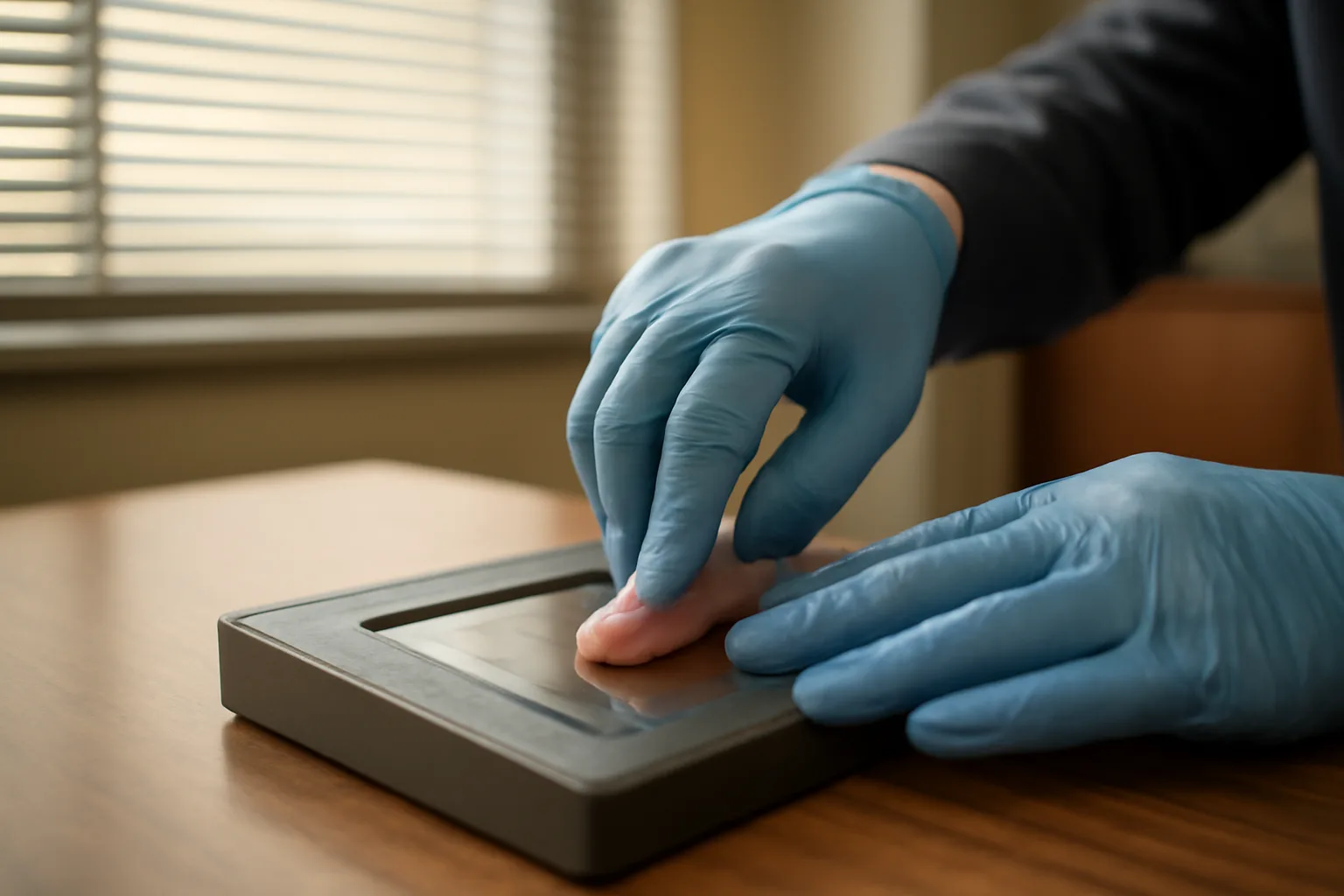
The core hardware is a live-scan fingerprint reader, a device that captures rolled and flat impressions electronically and transmits them as a digital record. Utah's submissions to BCI must conform to the FBI's Electronic Biometric Transmission Specification (EBTS), which defines image resolution, format, and quality requirements for acceptable prints [5].
The minimum capture resolution for ten-print records is 500 pixels per inch. Devices certified under the FBI's Product Qualification List (PQL) meet that standard [6]. Buying off the PQL is the safest move. A non-certified device is how you end up with rejected submissions.
Beyond the scanner, you need:
- Submission software. Most scanner vendors bundle proprietary software, but confirm it interfaces with your chosen submission channel (BCI's state system or an FBI-approved channeler). Ask your channeler before you buy hardware.
- A CJIS-compliant workstation. That means full-disk encryption, strong passwords, and an audit log. The FBI CJIS Security Policy details the technical controls required [2].
- A thermal or laser printer if you produce paper receipts for applicants.
- Inkless fingerprint wipes for quality control when someone has faint ridge detail.
For a first-time buyer, refurbished units from reputable vendors cut costs a lot. I'd spend on a device with an active support contract over a cheap unit with no software updates. EBTS requirements and BCI's transmission specs do change, and an orphaned device becomes a compliance problem.
How does BCI handle live-scan submissions and background checks?
When a technician captures a set of fingerprints, the records travel to BCI as a structured electronic file. BCI's Automated Fingerprint Identification System (AFIS) compares the prints against the state criminal history repository [1]. A response comes back either as "no record" or with criminal history information, depending on what the request's permissible purpose authorizes the requester to receive.
BCI also routes submissions to the FBI's NGI system for national checks when the requesting entity's program requires it. The FBI charges its per-transaction fee on top of BCI's state fee, and results feed back through BCI to the authorized requester.
Turnaround for electronic (live-scan) submissions is usually faster than inked-card submissions, often within 24 to 72 hours for state responses, though BCI does not publish a guaranteed service-level agreement. FBI national check times vary more, especially when a print hits the unsolved latent pipeline or needs manual review.
For technicians, the operational job is submitting clean, high-quality images. A poor scan returns as "fingerprint unclassifiable," which means the applicant comes back and pays again. That's bad for your reputation and your relationship with submitting agencies. Quality control happens at capture time, not at the submission stage. That's where you protect yourself.
What CJIS requirements apply to Utah live-scan technicians?
The FBI's Criminal Justice Information Services Security Policy applies to anyone who accesses Criminal Justice Information, which includes the fingerprint images themselves and the criminal history responses they generate [2]. This is federal policy, not Utah-specific, but it applies squarely to Utah technicians.
The key obligations for individual technicians:
Security awareness training. The CJIS Security Policy requires personnel with access to CJI to complete security awareness training within six months of hire and every two years after that [2]. The training covers proper handling of CJI, physical security, and appropriate use policies.
Background screening. Individuals with unescorted access to CJI must undergo a fingerprint-based state and national background check themselves [2]. This is a legal prerequisite, not a nice-to-have. If you operate a live-scan device and see the results, that check applies to you.
Physical and logical access controls. Workstations must sit in a physically secure location. Remote access, if used, requires multi-factor authentication and encrypted connections per CJIS policy.
The FBI publishes the CJIS Security Policy as a public document, and reading the policy and implementation sections is genuinely useful for anyone setting up a new fingerprinting operation. It's detailed and bureaucratic, but the requirements are what they are, and "I didn't know" is no defense when BCI audits your operation.
Should you work with a channeler or go direct through BCI?
This is one of the real forks in the road for a new Utah fingerprinting business.
Going direct through BCI means your entity negotiates an agreement to submit state checks straight to their system. You handle the technical connection, the security compliance documentation, and the ongoing relationship with BCI. For high-volume operators or institutions (a large school district, a staffing firm doing hundreds of checks monthly), this makes sense. You control the pipeline and you skip a channeler's per-transaction markup.
Working through an FBI-approved channeler means a third-party company receives your submissions, routes them to the FBI's NGI system (and often coordinates the state check too), and returns results to you. FBI-approved channelers are listed by the FBI's CJIS division [4]. The per-transaction cost is higher because the channeler takes a cut, but your compliance burden is lighter. The channeler handles much of the technical infrastructure, and their FBI agreement shifts some of the certification weight off your shoulders.
For a brand-new solo operator running a mobile fingerprinting business, channelers are the faster path to legally operational. The reduced upfront compliance work is usually worth the per-transaction cost, at least until volume justifies a direct relationship.
If you're thinking through the startup paperwork and infrastructure, LiveScanPath's $149 one-time Live-Scan Site Kit at /start lays out the document checklists, equipment sourcing notes, and operational templates that walk you through exactly this decision.
What does a live-scan technician actually do day-to-day in Utah?
The job is more customer service than it looks from the outside. Yes, you're rolling fingers on a piece of glass. The actual work involves explaining the process to nervous applicants, checking identity documents (a valid government-issued ID is required for most submissions), confirming print quality before the applicant leaves, handling rejected prints, and keeping your submission records organized for audits.
In Utah, common client types for third-party fingerprinting businesses include:
- Applicants for Utah educator licensing (the Utah State Board of Education requires fingerprint-based background checks for educator licensure) [7]
- Healthcare workers subject to Utah Department of Health and Human Services requirements
- Childcare and foster care applicants
- Financial industry employees subject to FDIC or FINRA fingerprinting requirements
- Private individuals applying for out-of-state jobs or professional licenses in states that require FBI background checks
Mobile services have grown in Utah because the state is large and some rural applicants face real access problems. A technician with a portable scanner serving rural counties fills a gap fixed-location services don't cover.
The operational cadence for most solo operators: book appointments (or take walk-ins), verify ID, capture prints, submit electronically, hand the applicant their transaction number, and maintain your logs. A ten-print session typically takes 10 to 20 minutes.
How does Utah compare to neighboring states on live-scan technician requirements?
Here's an honest comparison. Requirements shift over time, so treat this as directional, and confirm with each state's agency before acting on it.
| State | Dedicated technician license? | Primary oversight body | Notes |
|---|---|---|---|
| Utah | No | BCI (Dept. of Public Safety) | Compliance through entity agreements and CJIS |
| Arizona | No formal state license | AZ DPS | Similar BCI-equivalent structure |
| California | Live-scan operators register with DOJ | CA DOJ | More formal than Utah |
| Colorado | No dedicated board | CBI | Entity-level agreements, similar to Utah |
| Idaho | No dedicated board | Idaho State Police | Comparable to Utah's framework |
| Nevada | No dedicated board | NV DPS | Entity agreements required |
California is the clear outlier in the West. The live-scan technician board in California situation is its own topic. For the rest of the Mountain West, Utah's framework is pretty representative of what you'll find.
If you're eyeing expansion across state lines, the live-scan technician board in Arizona and live-scan technician board in Colorado guides are the most directly useful neighbors to read next.
How do you actually get started as a live-scan technician in Utah?
Here is the honest sequence, not a sanitized checklist.
First, decide your business model. Are you working for an employer that already has BCI access, or starting your own operation? These are very different paths. The employed route is faster and simpler. The independent route has more upfront work.
Second, complete your own background check. You cannot work with CJI without passing a fingerprint-based background check yourself. Get it done early because it can take a few weeks.
Third, contact BCI directly. The BCI site has program contact information [1]. Ask what their current process is for new entities wanting to submit live-scan records. The requirements are real, but BCI staff are generally responsive to straightforward questions. Do not rely on third-party summaries (including this one) for anything you'll be signing.
Fourth, decide on direct BCI submission versus channeler. If you're starting small, review the FBI's approved channeler list [4] and pick one that serves Utah. Get a clear per-transaction quote.
Fifth, procure your equipment. Match it to your chosen submission channel's technical requirements. Order early because delivery and configuration take time.
Sixth, complete CJIS security awareness training and document your security policy [2].
Seventh, get your local business license and any applicable zoning approvals if you're opening a physical location.
Total cost from zero to operational for an independent single-operator typically runs $4,000 to $18,000 depending on equipment choices and whether you lease or buy space. The wide range is real. At the low end you're buying a quality refurbished scanner, working from a home office with a compliant setup, and using a channeler. At the high end you're buying new equipment, renting commercial space, and standing up a direct BCI connection.
LiveScanPath covers the operational document side of this with the $149 Live-Scan Site Kit at /start. Use it for the paperwork scaffolding, not as a substitute for your actual BCI conversations.
Frequently asked questions
Do you need a license for live-scan technician in Utah?
No. Utah does not issue a live-scan technician license through any occupational licensing board. The Utah Division of Occupational and Professional Licensing (DOPL) does not list this occupation. What you do need is compliance with BCI entity agreements and FBI CJIS Security Policy requirements, including a personal background check and security awareness training every two years. These are regulatory obligations, not a licensure pathway.
How much does live-scan fingerprinting cost in Utah for the person being fingerprinted?
BCI charges $15 for a standard Utah state criminal history check. The FBI charges $13.25 per transaction for a national check submitted through an approved channeler. A third-party fingerprinting service typically adds a service fee on top, bringing total out-of-pocket costs for an applicant to roughly $30 to $60 depending on which checks are required and who does the service. Confirm current BCI fees directly with BCI before quoting.
How long does it take to become a live-scan technician in Utah?
If you're joining an employer that already has BCI access, you can be operational in days to a few weeks once you complete training and pass your own background check. Starting an independent fingerprinting business takes 1 to 3 months in most cases, driven by BCI agreement processing, equipment procurement, and CJIS compliance setup. There is no state licensing exam or mandatory waiting period.
What agency oversees live-scan fingerprinting in Utah?
The Utah Bureau of Criminal Identification (BCI), a division of the Utah Department of Public Safety, administers the state criminal history repository and sets submission requirements for fingerprint-based background checks. At the federal level, the FBI's Criminal Justice Information Services Division governs national check submissions and security compliance through its CJIS Security Policy.
Does Utah require CJIS training for live-scan technicians?
Yes, indirectly but firmly. The FBI CJIS Security Policy requires anyone with access to Criminal Justice Information, including fingerprint images and background check results, to complete security awareness training within six months of starting work and every two years after that. This federal requirement applies to Utah technicians regardless of whether Utah itself mandates it through state statute.
What equipment does a live-scan technician need in Utah?
You need a fingerprint scanner that meets FBI EBTS standards (minimum 500 ppi capture resolution) and appears on the FBI's Product Qualification List. You also need CJIS-compliant submission software, an encrypted workstation, and either a direct BCI submission agreement or an account with an FBI-approved channeler. Devices not on the PQL risk rejected submissions.
Can I run a mobile live-scan fingerprinting business in Utah?
Yes. Mobile fingerprinting operations are legal in Utah and fill a real gap in rural areas. You need the same BCI and CJIS compliance infrastructure as a fixed-location business, plus a portable scanner on the FBI's Product Qualification List. Some channelers have specific requirements about network connections for mobile submissions, so confirm technical specs before buying portable equipment.
What is a live-scan channeler and do I need one in Utah?
A channeler is an FBI-approved third party that receives your fingerprint submissions and routes them to the FBI's NGI system. Channelers are listed through the FBI's CJIS division. For a new Utah fingerprinting business, using a channeler is generally faster and less compliance-intensive than establishing a direct FBI connection. You pay a per-transaction fee to the channeler but avoid much of the technical certification burden upfront.
What background check does a live-scan technician in Utah need to pass themselves?
Anyone with unescorted access to Criminal Justice Information must undergo a fingerprint-based state and national background check as a condition of that access, per FBI CJIS Security Policy. In Utah that means submitting your own prints through BCI. Complete this early in your setup process; results can take days to weeks and you cannot legally work with CJI until it clears.
How do Utah's live-scan requirements compare to Arizona or California?
Utah and Arizona have similar frameworks: entity-level BCI or DPS agreements with no dedicated technician license. California is notably stricter; the California DOJ requires live-scan operators to register and follow specific DOJ rules, making it the most demanding state in the West. Utah's framework is relatively approachable by comparison, with compliance obligations centered on CJIS policy and BCI agreements rather than a formal licensing board.
What Utah laws govern fingerprint-based background checks?
Utah Code Title 53, Chapter 10 governs the Department of Public Safety and its criminal history repository functions, including BCI's authority to maintain and provide access to criminal records. Specific program requirements (teacher licensing, childcare, healthcare) sit across relevant licensing statutes in Title 53B, Title 62A, and Title 26B. Always check the specific statute for the program your submissions serve.
How much does it cost to start a live-scan fingerprinting business in Utah?
Expect $4,000 to $18,000 to get an independent operation running. The lower end assumes a quality refurbished scanner ($2,000 to $4,000), home office setup, and using a channeler. The higher end reflects a new scanner ($8,000 to $15,000), commercial space, and building a direct BCI submission connection. Software, training, and local business licensing add a few hundred dollars on top regardless of model.
Sources
- Utah Department of Public Safety, Bureau of Criminal Identification: BCI administers the Utah criminal history repository and sets submission rules; BCI fee for a standard state criminal history check
- FBI CJIS Division, Criminal Justice Information Services Security Policy: CJIS Security Policy requires security awareness training every two years and fingerprint-based background checks for individuals with CJI access
- Utah Division of Occupational and Professional Licensing, License Types: Live-scan fingerprint technician does not appear on Utah's list of regulated occupations
- FBI CJIS Division, Approved Channelers: FBI-approved channelers list; FBI national check fee of $13.25 per transaction
- FBI CJIS Division, Biometrics and Fingerprints: EBTS defines image quality and format standards for electronic fingerprint submissions, including 500 ppi minimum resolution
- FBI CJIS Division, Fingerprints and Other Biometrics: The FBI's product qualification process certifies live-scan devices meeting EBTS image quality standards for submission to NGI
- Utah State Board of Education, Educator Licensing Background Check Requirements: Utah State Board of Education requires fingerprint-based background checks for educator licensure
- Utah Code, Title 53 Chapter 10 (Department of Public Safety, Criminal History Repository): Utah statutory authority for BCI to maintain the criminal history repository and govern access to criminal records