Last updated 2026-08-18
TL;DR
Alaska has no live-scan technician license. What you need is authorization from the Alaska Department of Public Safety as an Applicant Processing Services vendor. That means a business license, FBI-certified equipment, manufacturer training, and your own background check. Startup costs run $6,000 to $25,000, and approval takes 8 to 12 weeks.
What is a live-scan technician, and what do they do in Alaska?
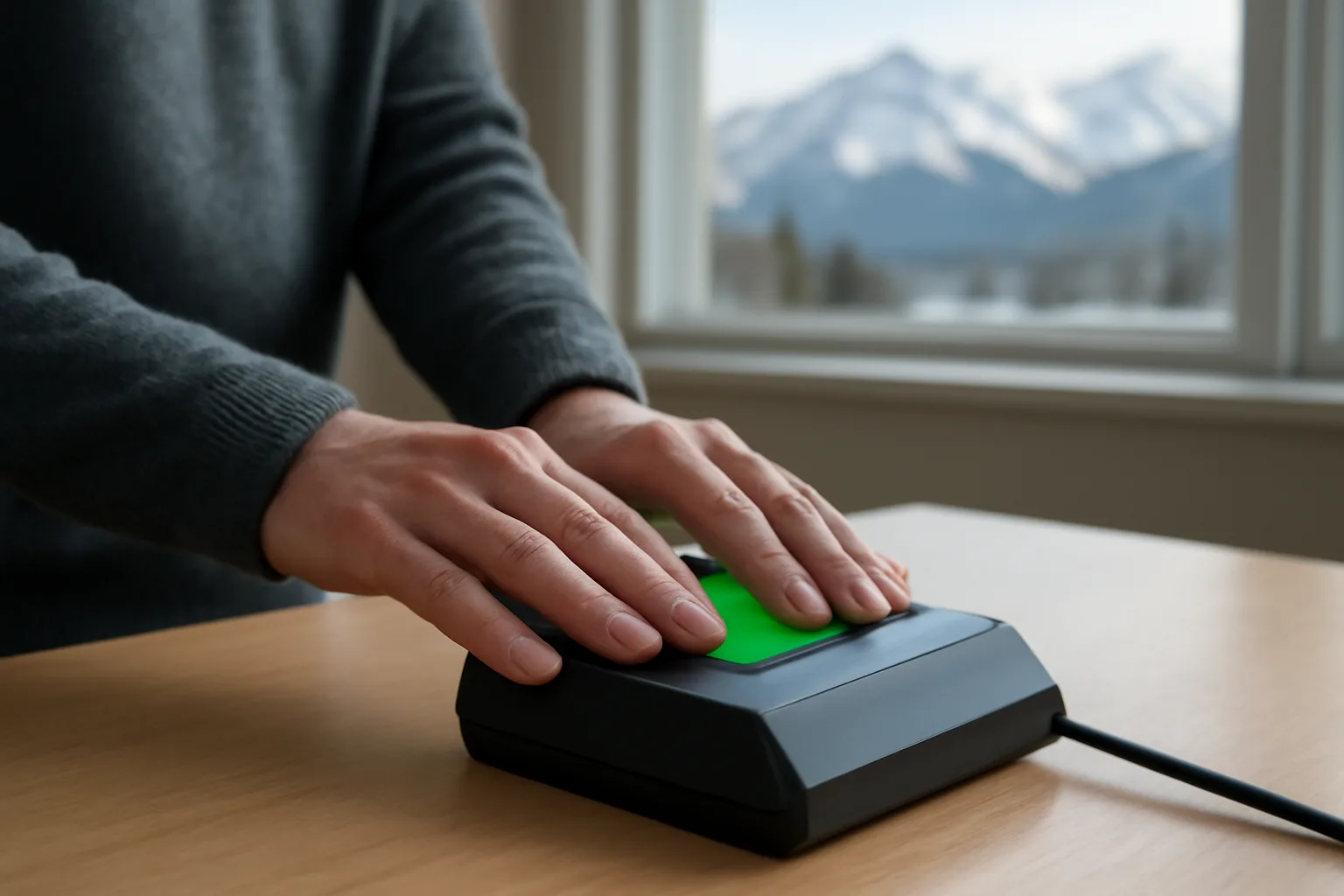
A live-scan technician captures fingerprints electronically instead of using ink and paper. The scanner reads ridge patterns, software formats the images, and the fingerprint record goes to the Alaska Department of Public Safety (DPS). From there it travels to state and FBI databases for a background check.
The job covers more than pressing a button. You work with employers who need pre-employment checks for oil and gas jobs, school districts hiring teachers, licensing boards vetting healthcare workers, and individuals applying for concealed handgun permits. Alaska statute AS 12.62.160(b)(8) says fingerprints for a background check must be taken by a criminal justice agency or "other entity authorized by law" [2]. That authorized entity is you. Your business fills the gap for people who don't want to line up at a police station.
Do you need a license to be a live-scan technician in Alaska?
No. Alaska issues no standalone "live-scan technician license" through a professional board. There's no exam, no state fingerprinting certificate, no hours-of-experience requirement. But you can't just buy a scanner and start submitting prints for background checks.
To legally submit fingerprints for employment, licensing, or permit purposes, you have to be an authorized agent of DPS under its Applicant Processing Services (APS) vendor program [1]. The program approves private businesses and individuals who meet security and training standards. Skip it, and the state repository rejects your transmissions on arrival. So while nobody calls it a license, the APS vendor authorization is your operating permit in everything but name. (Want the licensing model compared with other states? See live-scan technician license in Alaska.)
How do you become an authorized fingerprint vendor with Alaska DPS?
The path to APS vendor status runs in a clear order.
First, register for an Alaska business license from the Department of Commerce. It costs $50 and you can get it online in minutes [3].
Second, get an FBI-certified live-scan device and approved software. DPS keeps a list of compatible hardware. You don't need a specific brand, but the device must meet FBI Next Generation Identification (NGI) standards and the state's transmission format [8].
Third, finish the manufacturer's training for your device and keep the completion certificate. DPS wants proof before you submit a single print [1].
Fourth, fill out the APS Vendor Application. You provide your business license number, equipment details, a site security plan, and your own fingerprint background check (you pay the $40.25 processing fee) [4]. The application requires a physical location that meets CJIS security rules, even if you plan to run mobile. Mail the packet to DPS.
Fifth, DPS reviews everything, runs any security audit it wants, then has you sign a formal vendor agreement. Once that's done, you're listed as an authorized vendor and can start taking customers.
How much does it cost to start a live-scan technician business in Alaska?
Equipment is the big line item. A new FBI-certified live-scan capture device and software runs about $5,000 on the low end for a basic ten-print scanner, up to $20,000 for a dual-iris, multi-finger workstation with photo capture [5]. Plenty of Alaska startups pick a mobile-friendly compact ten-print scanner in the $7,000 to $10,000 range.
Here's the rest of what you'll spend:
• Alaska business license: $50 per year [3] • Your own fingerprint background check: $40.25 [4] • Training: usually bundled with the device, but if separate, $500 to $1,500 • General liability and data breach insurance: $500 to $1,500 a year [6] • Office or mobile unit costs, internet, and supplies: variable, roughly $200 to $500 a month
Realistic startup capital lands between $6,000 and $25,000. A used live-scan machine from a retiring vendor can cut the hardware cost in half, and that's the smartest first move if you can find one on the approved list. For fee comparisons in other western states, see live-scan technician cost in Utah.
How long does it take to launch a live-scan business in Alaska?
Don't expect to buy a scanner Monday and take appointments Friday. Start to first paying customer usually takes 8 to 12 weeks.
Here's the honest breakdown:
• Business license: instant online, with the PDF certificate emailed within 1 to 2 business days. Alaska now issues digital certificates immediately in many cases. • Equipment procurement and shipping: 2 to 4 weeks, unless a dealer has your unit in stock. • Training: 1 to 2 weeks, often self-paced online. • DPS vendor application review: 4 to 6 weeks from the day they receive a complete packet. That window includes your fingerprint-based background check, which DPS won't rush. Incomplete applications add weeks.
Live in a remote town and DPS wants to see your site? Add another 2 to 3 weeks for scheduling. None of these timelines are guaranteed. (Curious how cold-weather states handle mobile setups? Our Vermont startup guide covers similar logistics.)
What equipment and software do you need for live-scan in Alaska?
The live-scan capture device is your core gear. DPS requires that it sits on the FBI's list of certified devices and can send images in the EFTS format (Electronic Fingerprint Transmission Specification) [8]. Units common among Alaska vendors include the Cross Match L Scan family, HID Global livescan pads, and Integrated Biometrics five-finger scanners.
You'll also need:
• A computer with a secure, fully patched operating system (Windows) and FBI-approved fingerprint transaction software. • A signature capture pad for applicant consent forms. • A digital camera if your service includes photo capture for identity verification. • A secure internet connection that meets CJIS Security Policy encryption standards [7]. • A printer for receipts and applicant copies.
Buy nothing until you've checked the current DPS approved equipment list [1]. The list changes as new models get certified. An off-list scanner, even one that's FBI-certified, might not talk to Alaska's state submission portal.
Where is the demand for live-scan services in Alaska?
Demand clusters in the Mat-Su Borough and Anchorage, then Fairbanks and Juneau. Oil and gas companies require fingerprint-based background checks for contractor employees. School districts, hospitals, and the concealed handgun permit unit at the Alaska State Troopers all send steady traffic.
Concealed carry permits alone keep many technicians busy. Alaska had roughly 100,000 active permit holders as of 2021, and each renewal needs a fresh set of prints.
Small communities like Ketchikan, Sitka, and Kodiak often have no local fingerprinting provider. A mobile technician who visits once a month can capture weeks of demand in two days. That model works. You just have to price in winter travel and a portable unit that meets CJIS physical security rules inside a locked vehicle.
What are the ongoing requirements to stay compliant as an Alaska live-scan technician?
Authorization isn't one-and-done. The DPS vendor agreement carries renewal terms, and most require annual re-approval with updated paperwork. You also keep your Alaska business license active, renewed every year [9].
On the operational side, you follow the FBI CJIS Security Policy to the letter [7]. That means:
• Keeping an audit trail of every fingerprint transmission. • Securing the physical space during fingerprinting (a locked door or partition in a shared office). • Encrypting all data in transit. • Running background checks on any employee who can access fingerprint data. • Reporting any security incident to DPS fast, per your agreement terms.
Miss these and DPS can terminate your vendor agreement outright. For how different state boards handle oversight, see live-scan technician board in Utah.
Common pitfalls when starting a live-scan business in Alaska
The priciest mistake is buying equipment before confirming it's on the DPS approved list. New owners spend $12,000 on a scanner a sales rep swore was compatible, then learn it can't submit to Alaska's portal because of a software version mismatch. That money is gone.
Second mistake: ignoring mobile unit security. CJIS rules say the workstation lives in a locked, access-controlled area. A van with a scanner on the passenger seat doesn't cut it. You need a hard enclosure or a briefcase setup that locks when unattended.
Third: undercharging. Some startups figure $25 per capture plus the state's $40.25 background check fee looks competitive. After gas, insurance, and machine amortization, that leaves nothing. Anchorage competitors charge $60 to $85 for a full capture and submission. Price to survive.
Fourth: skipping data breach insurance. One lost thumb drive of raw fingerprint images can end your business and drain your personal finances. General liability alone won't save you. Buy a policy that names biometric data.
Where to get the paperwork without the headache
Every form you need sits on the DPS website for free. The catch is that the vendor packet plays hide-and-seek: forms scattered across pages, outdated PDFs still indexed by search engines, and a cover checklist pointing at an equipment list that changed months ago.
LiveScanPath sells an Alaska Live-Scan Site Kit for $149. It bundles the current DPS vendor application forms, the equipment approval checklist, a sample security plan template, and a step-by-step walkthrough. The kit doesn't replace the state application and it doesn't guarantee approval. It just gathers the paper path in one place when you'd rather not spend an afternoon digging through DPS subpages. Comfortable working .gov sites yourself? Go the free route. Want the bundle? Grab it at /start.
Frequently asked questions
Do you need a license for live-scan technician in Alaska?
No. Alaska requires no separate occupational license for live-scan technicians. You do need authorization from the Alaska Department of Public Safety as an Applicant Processing Services vendor. That involves a business license, FBI-certified equipment, manufacturer training, and a signed vendor agreement before you can submit any prints.
How much does live-scan technician cost in Alaska?
Startup costs run $6,000 to $25,000. The live-scan device is the biggest expense at $5,000 to $20,000. Add the Alaska business license ($50), your own fingerprint check ($40.25), training, and general liability insurance. Operating costs like mobile travel and internet pile on monthly.
How long does live-scan technician take in Alaska?
Expect 8 to 12 weeks from start to first paid client. That's 2 to 4 weeks for equipment delivery and setup, 1 to 2 weeks for training, and 4 to 6 weeks for DPS to process your vendor application and background check. A remote site visit can add more.
Can I operate a mobile live-scan service in Alaska?
Yes, if you meet CJIS physical security requirements. Your unit must sit in a locked, controlled area when unattended. Many technicians use a wheeled lockbox or a briefcase workstation that secures in a vehicle trunk. DPS expects you to describe your mobile security plan in the vendor application.
What background check does a live-scan technician need for themselves?
You submit a full set of fingerprints for a state and FBI background check as part of the APS vendor application. The fee is $40.25. DPS won't approve an application with a disqualifying criminal history, especially offenses involving fraud, theft, or violence.
Is there a list of approved live-scan equipment for Alaska?
Yes. DPS keeps a current approved equipment and software list for vendors. It covers devices that passed FBI NGI certification and integrate with Alaska's submission portal. Check it before you buy. An FBI-certified device that isn't on Alaska's list will not work.
How much can I charge per fingerprint scan in Alaska?
Established technicians in Anchorage charge $60 to $85 for the capture and electronic submission, separate from the $40.25 state and FBI background check fee. Rural areas with no competition can go higher. You set your own price, but cutting it too far makes the business unsustainable.
Do I need a brick-and-mortar office in Alaska?
Not strictly. You can run from a home office or as a mobile service, provided your workspace meets CJIS access controls. A home office needs a locked door and a policy that only authorized people enter during fingerprinting sessions. DPS may request a photo or diagram with your application.
What insurance does a live-scan technician need in Alaska?
At minimum, general liability plus a policy covering data breach or cyber liability. Standard general liability runs about $500 to $1,500 per year. Because you handle biometric data, insurers may ask about your security procedures. An errors and omissions policy is smart too.
Can I submit fingerprints directly to the FBI from Alaska?
No, not as a private vendor. All non-criminal-justice fingerprint submissions to the FBI route through Alaska DPS as the channeling agency. Your device sends the files to DPS, which forwards them to the FBI. You never transmit to the FBI yourself.
How often do I renew the DPS vendor agreement?
Most vendor agreements renew annually. DPS sends a renewal notice with updated forms and may require a fresh background check. Miss the deadline and your authorization lapses, so your submissions get rejected. Renewal is usually simpler than the first application.
What happens if my vendor application is denied?
DPS sends a denial letter stating the reason. Common causes are incomplete paperwork, a disqualifying background check, or equipment that fails to meet standards. You can usually fix the deficiency and reapply. There's no formal appeals board; the decision rests with the DPS Director.
Sources
- Alaska DPS, APS Vendor Application Packet: Requirements for becoming an authorized fingerprint vendor, including equipment, training, and site security standards.
- Alaska Statutes AS 12.62.160(b)(8): Only a criminal justice agency or other entity authorized by law may take fingerprints for a background check.
- Alaska Dept. of Commerce, Business License Fees: Alaska business license fee is $50 for one year.
- Alaska DPS, Fingerprint Processing Fees: Fingerprint background check fee is $40.25, covering state and FBI processing.
- Mordor Intelligence, Live-Scan Biometrics Market Report: Live-scan biometric devices cost between $5,000 and $20,000, with market segmentation for portable units.
- Insureon, General Liability Insurance Cost: General liability insurance for small fingerprinting businesses typically costs $500 to $1,500 annually.
- FBI CJIS Security Policy Resource Center: CJIS Security Policy applies to all non-criminal justice fingerprint data handling and equipment.
- FBI Certified Products List, Biometric Specifications: List of FBI-certified live-scan capture devices, a prerequisite for DPS vendor approval.
- Alaska Dept. of Commerce, Business License Renewal: Alaska business licenses must be renewed every year.