Last updated 2026-08-18
TL;DR
In Arkansas you become a live-scan technician by registering as a Fingerprint Service Provider with the Arkansas State Police Identification Bureau. There is no standalone license and no state exam. Expect roughly $2,000 to $4,000 upfront, a fingerprint-based background check on yourself, FBI-certified equipment, and a 4 to 6 week setup before you can print for others. It's paperwork and hardware, not a board test.
What a live-scan technician in Arkansas actually does
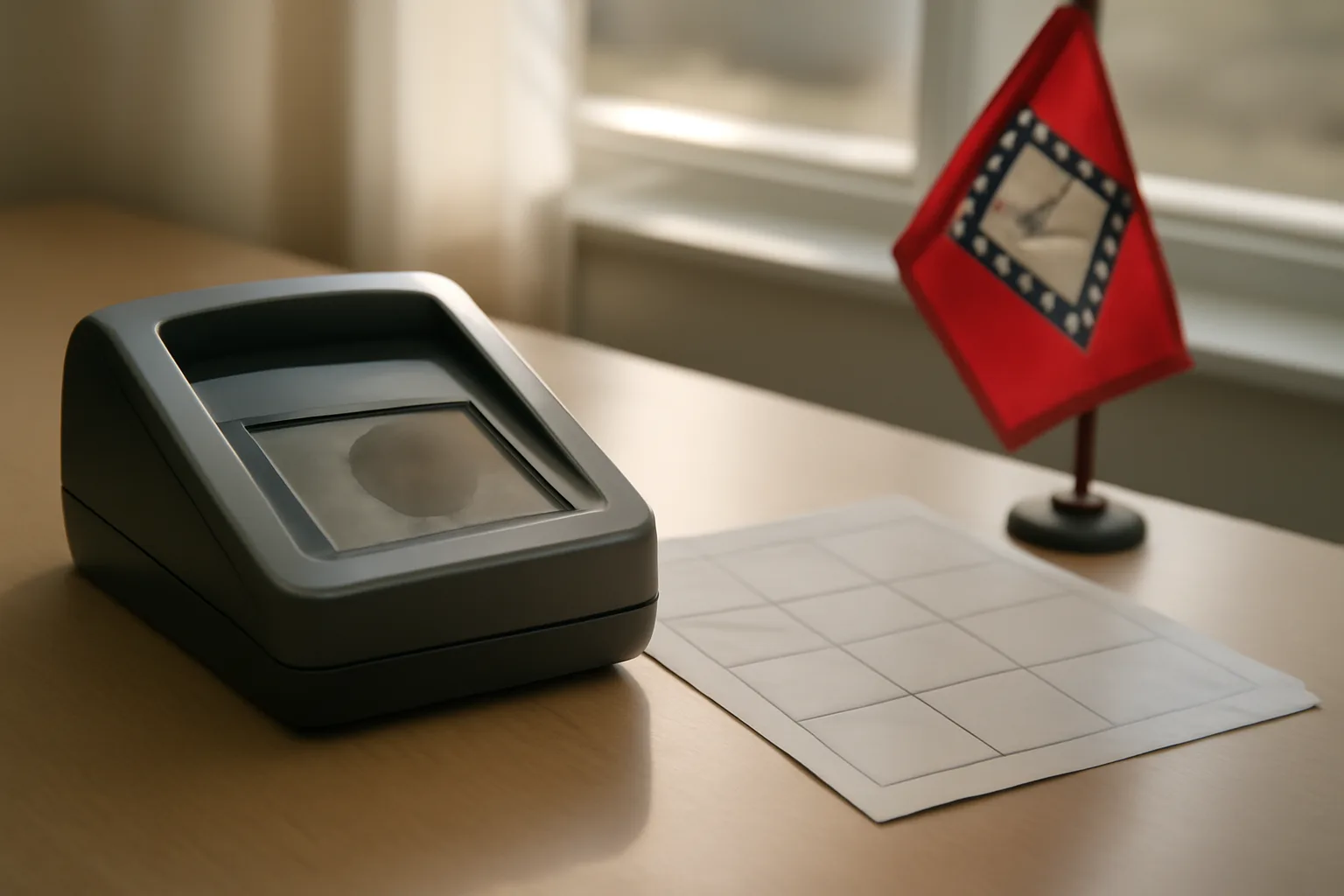
A live-scan technician captures fingerprints electronically and sends them to the Arkansas State Police (ASP) Automated Fingerprint Identification System (AFIS) for criminal history checks. Ink-and-roll cards are the old way. Live-scan digitizes prints on the spot, then runs them against state and FBI databases.
The job has two halves. Operate the machine well enough that rejections stay rare. Stay inside the provider agreement ASP makes you sign.
In practice you'll print teachers, nurses, real estate agents, foster parents, and anyone who needs a background check for a license or a job. You don't decide anything. You collect the data. But if your prints come back unreadable, or your scanner isn't on the approved list, the whole background check stalls and the applicant blames you.
Most technicians work as independent businesses, mobile providers, or staff inside a fingerprinting agency. The state leans on private providers to do the actual print collection. Storefront or car trunk, the foundation is identical: an ASP-authorized provider running FBI-certified equipment.
Do you need a license for live-scan technician in Arkansas?
No. Arkansas does not issue a "live-scan technician license." The Arkansas State Police Identification Bureau runs a Fingerprint Service Provider program under its statutory authority [1]. To print for others legally, you apply to become an approved provider, pass a background check, and run FBI-certified live-scan devices. The state treats this as a registration, not a license.
There's no board exam. No continuing education requirement. No fingerprint technician board sitting in judgment. Control lives with the ASP Identification Bureau and the FBI's Criminal Justice Information Services (CJIS) division.
Here's what ASP wants. You fill out a Fingerprint Service Provider Application. You get fingerprinted yourself for a state and FBI record check. You list every live-scan device you plan to use, and each one has to appear on the FBI's Appendix F list and clear Arkansas AFIS connectivity. Once ASP approves you, your name goes on the public list of approved providers. That listing is your green light.
If someone tells you to go find your "live-scan technician license Arkansas" number, they're describing a different state's rules. For more on why this is a registration and not a license, see our live-scan technician license in Arkansas guide.
The step-by-step paper path
The sequence is linear, and every step gates the next one.
1. Get the provider application. Download the Fingerprint Service Provider Application from the ASP website or request it by phone from the Identification Bureau. It's usually a PDF with fields for business name, physical address, equipment models, and a signed agreement to the provider terms [6].
2. Get yourself printed. You undergo a fingerprint-based background check using your own prints. Book at an existing live-scan location or a law enforcement agency that submits electronically. The ASP processing fee for a criminal background check is $10 [2], and the FBI portion adds $19.25. These are the same fees your future clients pay. As an applicant, you pay them too. Your prints go to AFIS and the FBI, and results go straight to ASP.
3. List your device. You can't use any scanner off the shelf. The device must sit on the FBI's list of Certified Live Scan Devices (Appendix F compliant) and be tested for Arkansas AFIS submissions [5]. The application asks for manufacturer, model, and serial number. ASP checks it against the approved list before signing off.
4. Handle business registration. ASP doesn't require it, but your city or county probably does. Arkansas has no statewide business license for fingerprinting, so local rules vary. The Arkansas.gov business portal points you to county clerks [8]. Budget $50 to $150 depending on where you set up.
5. Submit everything. Mail or email the completed form, your background check authorization, and a check for the application fee (around $25, confirm the current figure with ASP). Processing usually runs 2 to 4 weeks [3]. Once approved, your business shows up on the ASP approved provider list and you can connect your device to the AFIS network.
No in-person interview. No technician license number. Just the registration and the right hardware.
How much does a live-scan technician cost in Arkansas?
Startup costs fall into four buckets. The figures below come from ASP fee schedules and FBI device lists as of 2026. Confirm current numbers with the bureau before you write any check.
| Cost Category | Estimated Amount | Notes |
|---|---|---|
| ASP provider application fee | $25 | One-time; subject to change |
| Applicant background check (state + FBI) | $29.25 to $45 | Higher if done at an outside live-scan site |
| FBI-certified live-scan device | $1,500 to $3,500 | New purchase; lease options exist |
| Local business license | $50 to $150 | Depends on city or county |
| Training | $0 to $300 | ASP guidance is free; third-party courses optional |
Buy mid-range equipment and your realistic upfront range is $2,000 to $4,000. The annual renewal fee for the vendor registration is $50 [4], plus per-transaction costs. ASP charges $10 per fingerprint transaction for civil background checks [2], and the FBI adds $19.25 for federal checks. You bake those into your client price, so clients effectively reimburse you every time you submit.
Charge a client $40 per scan against $29.25 in underlying fees and your gross margin is about $10.75 per scan, before equipment depreciation and your own time. That margin is thin. Volume is the whole game.
What trips people up? Mobile paperwork supplies, backup ink cards, professional liability insurance (roughly $300 to $600 a year), and a dedicated secure internet connection for AFIS transmissions. The device is the wild card. A used, older unit off eBay might hold FBI certification and still fail ASP's connectivity test. I'd buy new from a known maker like Crossmatch (HID) or Biometrics4ALL and skip the gamble.
How long does it take to get started?
Move efficiently and the whole run from application to first paid print takes 4 to 6 weeks. Here's the usual breakdown.
Week 1 to 2: gather the application, book your own background check, and order equipment. The check itself clears within a day if you use a live-scan location that submits electronically to AFIS. Departments still running ink cards will drag you out, so pick an electronic site.
Week 2 to 4: ASP processes your provider application and background check. Official guidance says to allow 2 to 4 weeks for provider approvals [3]. Clean, error-free applications often clear faster. If your background check turns up a disqualifying offense, ASP denies the application. No appeal window is written into statute, so you'd need to resolve the record or wait out the disqualification.
Week 3 to 5: equipment setup. A new device usually ships within a week. Once it lands, you install the software, configure the IP address for AFIS, and run test transactions through the sandbox ASP provides. Some manufacturers throw in remote setup help. Plan on a few hours to a full day to get it dialed in.
Week 4 to 6: once ASP confirms approval and your test prints come back clean, start offering services. Don't market before you're on the list. Any prints you submit before approval are unauthorized and can get your whole application pulled. Buy from a vendor that pre-configures the device for Arkansas AFIS and the timeline shrinks.
Live-scan equipment that won't get you rejected
The device is the business. Arkansas requires your scanner and software to be FBI Appendix F compliant and tested for interoperability with the Arkansas AFIS system. The FBI publishes the list of certified devices on its CJIS site [5]. At minimum you need a tenprint scanner, a PC or laptop that meets the maker's specs, a high-speed connection with a static IP, and AFIS-approved capture software.
Models you'll see around Arkansas: the Crossmatch (now HID) Guardian series, the Biometrics4ALL Live Scan Station, and the Idemia MorphoWave. A new unit runs $1,800 to $3,200. Some models lease for $80 to $120 a month, which helps early cash flow. Used units from clinics that upgraded show up cheap, but you have to verify the serial number against the FBI list and then re-register the device with ASP. Get your device listing rejected and you've burned time and money.
On the paperwork side, our LiveScanPath Live-Scan Site Kit ($149) packages the state-specific application, checklists, and a step-by-step walkthrough. It isn't hardware. It's the guide that keeps first-timers from missing the supplemental documents ASP quietly expects.
Keep a backup, too. An approved technician should stock FD-258 fingerprint cards and an ink pad for people with dry or worn fingers the scanner can't read. ASP allows ink-to-live-scan conversion, but only if you're already an approved provider.
Where the work comes from in Arkansas
Your clients are people who need fingerprint-based background checks required by state or federal rules. In Arkansas that means applicants for teaching licenses, nursing licenses, real estate licenses, concealed handgun carry permits, and foster care or adoption. Many state agencies send applicants straight to the ASP approved provider list. Getting on that list is your single biggest marketing channel, and it's free.
Per-scan pricing in Arkansas runs $30 to $50. Charge $40 against $29.25 in state and FBI fees and you keep about $10.75 before travel. At 20 scans a week, that's $215 in gross profit weekly, roughly $860 a month. Add mobile convenience fees ($10 to $20 per trip) and you push higher.
Real volume comes from contracts: school districts, healthcare staffing agencies, companies running dozens of applicants a month. Winning those means reliable equipment, quick turnaround, and near-zero rejections. New technicians often build their name doing mobile, on-site fingerprinting for groups on weekends.
Be honest about year one. Most solo part-timers report 10 to 15 scans a week after six months of networking. That's not a living. It's a foundation of repeat clients. In a metro like Little Rock or Fayetteville, density feeds you volume. In a rural county you might be the only provider for 50 miles, which lets you charge more but see fewer people.
Renewals, audits, and staying on the approved list
The Fingerprint Service Provider approval isn't forever. ASP requires annual re-registration. The AFIS vendor portal shows your expiration date. Submit the renewal application and the $50 annual fee [4] at least 30 days before it lapses. Let it expire and you drop off the approved provider list immediately, and getting back on means restarting the background check.
The FBI also audits live-scan operators who submit federal checks. Auditors can ask for transaction logs, print quality samples, and proof your device still holds its Appendix F certification. Fail an audit and the FBI can suspend your originating agency identifier (ORI). Without an active ORI you can't submit to the federal database at all. Most technicians never get audited in a given year, but organized records mean you pass without panic if you do.
One compliance risk nobody talks about: an expired or unqualified device. Even with an approved business, submitting prints from a scanner that isn't on the current FBI list breaks the provider agreement, and ASP can revoke you. Same goes for knowingly printing someone trying to duck a legal prohibition. You're held to the same ethics as any fingerprint taker. The application agreement lays this out. Read it twice.
For the licensing-versus-registration distinction, visit our live-scan technician license in Arkansas page. Comparing startup costs with nearby states? See how to start a live-scan technician in Alabama or Alaska's live-scan license process. Utah's board and licensing structure makes a useful contrast.
Frequently asked questions
What background check is required to become a live-scan technician in Arkansas?
You undergo a fingerprint-based criminal history check through the Arkansas State Police and the FBI. Submit your own prints as part of the provider application. ASP reviews the results, and serious convictions can disqualify you. The state processing fee is $10 [2] and the FBI fee is $19.25. No credit check or employment history review is part of it.
Can I do mobile live-scan fingerprinting in Arkansas?
Yes. As an approved Fingerprint Service Provider you can carry a portable live-scan device to client sites. You need a secure internet connection for AFIS transmission. Plenty of technicians run entirely mobile, serving nursing homes, schools, and small businesses. Just make sure the mobile device is the same model on your ASP approval and keep transaction records that meet FBI guidelines.
Do I need an FBI certification separate from the state's approval?
No. There's no separate FBI certification exam for individual technicians. Your live-scan device does have to be FBI Appendix F certified, and you'll be assigned an ORI for federal submissions. The FBI's requirements are satisfied through the ASP provider agreement and compliance with CJIS security policies.
What live-scan devices are approved in Arkansas?
Any device on the FBI's published list of certified live-scan devices (Appendix F) that has also cleared Arkansas AFIS connectivity. Common models include the Crossmatch/HID Guardian, Biometrics4ALL, and Idemia MorphoWave. Check the FBI CJIS site for the current list [5] and confirm with ASP before you buy.
Do I need a business license in addition to the ASP registration?
Arkansas has no statewide license for fingerprinting services, but most cities and counties require a general business license. The fee is usually $50 to $150, and you get it from the local county clerk or city hall. Check the Arkansas.gov business portal [8] for your location's rules.
How much can a live-scan technician earn in Arkansas?
Per-scan gross profit averages $10 to $15 after state and FBI fees. At 15 to 20 scans a week, that's $600 to $1,200 a month before overhead. Full-time operators with contracts earn more. Building volume takes time, and first-year part-time income often lands around $10,000 to $15,000 gross.
Does Arkansas require any live-scan training class?
No. There's no state-mandated training course. ASP provides basic guidance on transactions and error codes. Some equipment vendors offer optional training. Self-taught is common, but you have to prove competence by submitting clean test prints during setup.
Can I submit fingerprints for out-of-state background checks?
Yes, but only if the receiving state or agency accepts electronic submissions from an Arkansas AFIS-linked provider. Most states accept FBI-channel results, though some require state-specific routing. Confirm with the requesting agency before you take the prints.
How do I renew my Fingerprint Service Provider approval?
Log in to the Arkansas.gov AFIS vendor portal and submit the renewal application before your expiration date. The annual fee is $50 [4]. Late renewals can trigger a new background check. Keep your device list and contact information current so nothing bounces.
Are there ongoing fees per fingerprint submission?
Yes. For each state background check ASP charges $10 [2], and for federal checks via the FBI an additional $19.25 applies. You remit those to ASP. There may also be a small per-transaction AFIS network fee. These are pass-through costs you fold into your client pricing.
What if my application is denied by ASP?
Denials usually come from a disqualifying criminal record or incomplete paperwork. ASP sends a letter explaining the reason. You can reapply once the disqualification is resolved. No formal appeal process is defined in statute, but you can contact the Identification Bureau directly for guidance on your specific record.
How is the Arkansas AFIS system different from other states?
Arkansas AFIS operates under Ark. Code Ann. § 12-12-1001 and is maintained by the ASP Identification Bureau. It interfaces with the FBI's National Fingerprint File. Providers must use specific connectivity protocols. Other states may use different vendors or require a separate state-only certification on top of the FBI channel.
Sources
- Arkansas State Police Identification Bureau: ASP Identification Bureau operates the AFIS system and oversees fingerprint service providers under statutory authority Ark. Code Ann. § 12-12-1001.
- ASP Criminal Background Check: State fingerprint processing fee is $10 per civil check.
- Arkansas.gov AFIS Vendor Information: Vendor registration application processing takes 2-4 weeks.
- Arkansas.gov AFIS Vendor Fees: Annual provider registration renewal fee is $50.
- FBI CJIS Approved Live Scan Devices: FBI lists Appendix F certified live-scan devices.
- ASP Fingerprint Service Provider Application: Application form with equipment listing and fee.
- Arkansas.gov Business Portal: Local business license information by county.